Mount Thompson (Alberta)
| Mount Thompson | |
|---|---|
 Mount Thompson seen from Icefields Parkway at Bow Lake. Portal Peak to left. | |
| Highest point | |
| Elevation | 3,089 m (10,135 ft) [2] |
| Prominence | 369 m (1,211 ft) [1] |
| Parent peak | Mount Baker (3180 m)[1] |
| Coordinates | 51°39′50″N 116°31′22″W / 51.66389°N 116.52278°W / 51.66389; -116.52278Coordinates: 51°39′50″N 116°31′22″W / 51.66389°N 116.52278°W / 51.66389; -116.52278 [3] |
| Geography | |
  Mount Thompson Location of Mount Thompson in Alberta Show map of Alberta 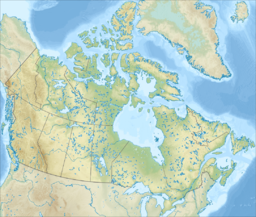 Mount Thompson Mount Thompson (Canada) Show map of Canada | |
| Location | Alberta, Canada |
| Parent range | Waputik Mountains Canadian Rockies |
| Topo map | NTS 82N10[3] |
| Geology | |
| Age of rock | Cambrian |
| Type of rock | Sedimentary |
| Climbing | |
| First ascent | 1898 by J. Norman Collie, Hugh Stutfield, H. Woolley[4] |
| Easiest route | Scrambling Southwest slope |

Mount Thompson upper right
Mount Thompson is a 3,089 meter summit located four kilometers west of Bow Lake in Banff National Park, in the Canadian Rockies of Alberta, Canada. Its nearest higher peak is Mount Baker, 5.0 km (3.1 mi) to the west.[1] Mount Thompson is situated east of the Wapta Icefield, and is a member of the Waputik Mountains. Mount Thompson can be seen from the Icefields Parkway at Bow Lake.
Contents
1 History
2 Geology
3 Climate
4 See also
5 References
6 External links
History
Mount Thompson is named for Charles Sproull Thompson (1869-1921) who participated in numerous first ascents in the Canadian Rockies. In August of 1897, Charles Thompson, Hugh Stutfield, and J. Norman Collie camped on the shores of Bow Lake; then proceeded to climb the Bow Glacier, which at that time descended farther down into the valley; then crossed the Wapta Icefield to attain the summit of Mount Gordon. From Mount Gordon they were surrounded by unnamed mountains and named one of them Mount Thompson.[5] The first ascent of Mount Thompson was made the following year (1898), by Norman Collie, Hugh Stutfield, and Herman Woolley.[6] The mountain's name became official in 1928 by the Geographical Names Board of Canada.[3] Charles Thompson named Portal Peak which is a subsidiary peak located 1.5 km southeast of his peak. Portal Peak flanks one side of Bow Glacier, which in 1897 was considered the portal to the Wapta Icefield.[1]
Geology
Mount Thompson is an overthrust peak situated between the Bow Glacier and Peyto Glacier.[1] Like other mountains in Banff Park, Mount Thompson is composed of sedimentary rock laid down during the Precambrian to Jurassic periods.[7] Formed in shallow seas, this sedimentary rock was pushed east and over the top of younger rock during the Laramide orogeny.[8]
Climate
Based on the Köppen climate classification, Mount Thompson is located in a subarctic climate with cold, snowy winters, and mild summers.[9] Temperatures can drop below -20 C with wind chill factors below -30 C. Precipitation runoff from Mount Thompson drains into the Bow River which is a tributary of the Saskatchewan River.
See also
- List of mountains of Canada
References
^ abcde "Mount Thompson". Bivouac.com. Retrieved 2018-10-16..mw-parser-output cite.citation{font-style:inherit}.mw-parser-output .citation q{quotes:"""""""'""'"}.mw-parser-output .citation .cs1-lock-free a{background:url("//upload.wikimedia.org/wikipedia/commons/thumb/6/65/Lock-green.svg/9px-Lock-green.svg.png")no-repeat;background-position:right .1em center}.mw-parser-output .citation .cs1-lock-limited a,.mw-parser-output .citation .cs1-lock-registration a{background:url("//upload.wikimedia.org/wikipedia/commons/thumb/d/d6/Lock-gray-alt-2.svg/9px-Lock-gray-alt-2.svg.png")no-repeat;background-position:right .1em center}.mw-parser-output .citation .cs1-lock-subscription a{background:url("//upload.wikimedia.org/wikipedia/commons/thumb/a/aa/Lock-red-alt-2.svg/9px-Lock-red-alt-2.svg.png")no-repeat;background-position:right .1em center}.mw-parser-output .cs1-subscription,.mw-parser-output .cs1-registration{color:#555}.mw-parser-output .cs1-subscription span,.mw-parser-output .cs1-registration span{border-bottom:1px dotted;cursor:help}.mw-parser-output .cs1-ws-icon a{background:url("//upload.wikimedia.org/wikipedia/commons/thumb/4/4c/Wikisource-logo.svg/12px-Wikisource-logo.svg.png")no-repeat;background-position:right .1em center}.mw-parser-output code.cs1-code{color:inherit;background:inherit;border:inherit;padding:inherit}.mw-parser-output .cs1-hidden-error{display:none;font-size:100%}.mw-parser-output .cs1-visible-error{font-size:100%}.mw-parser-output .cs1-maint{display:none;color:#33aa33;margin-left:0.3em}.mw-parser-output .cs1-subscription,.mw-parser-output .cs1-registration,.mw-parser-output .cs1-format{font-size:95%}.mw-parser-output .cs1-kern-left,.mw-parser-output .cs1-kern-wl-left{padding-left:0.2em}.mw-parser-output .cs1-kern-right,.mw-parser-output .cs1-kern-wl-right{padding-right:0.2em}
^ "Mount Thompson, Alberta". Peakbagger.com.
^ abc "Mount Thompson". Geographical Names Data Base. Natural Resources Canada. Retrieved 2018-10-18.
^ Mount ThompsonPeakFinder
^ Mount ThompsonPeakFinder
^ Mount ThompsonPeakFinder
^ Belyea, Helen (1960). "The Story of the Mountains in Banff National Park". Geological Survey of Canada.
^ Gadd, Ben (2008). "Geology of the Rocky Mountains and Columbias".
^ Peel, M. C.; Finlayson, B. L. & McMahon, T. A. (2007). "Updated world map of the Köppen−Geiger climate classification". Hydrol. Earth Syst. Sci. 11: 1633–1644. ISSN 1027-5606.
 | Peyto Peak | Caldron Peak | Mount Jimmy Simpson |
| |||
Peyto Glacier |  | Icefields Parkway | |||||
Mount Baker |  Mount Thompson Mount Thompson  | Bow Lake | |||||
Mount Habel |  | Crowfoot Mountain | |||||
Wapta Icefield | Mount Olive | Bow Glacier |
External links
- Parks Canada web site: Banff National Park
.mw-parser-output .navbox-canada .navbox-title,.mw-parser-output .navbox-canada th,.mw-parser-output .navbox-canada .navbox-group,.mw-parser-output .navbox-canada .navbox-abovebelow,.mw-parser-output .navbox-canada .navbox-subgroup,.mw-parser-output .navbox-canada .navbox-odd,.mw-parser-output .navbox-canada .navbox-even{background-color:white}.mw-parser-output .navbox-canada .navbox-list .collapsible .navbox-title{box-shadow:inset 1px 1px 0 #C00,inset -1px -1px 0 #C00}.mw-parser-output .navbox-canada-a{box-shadow:inset 1px 1px 0 #C00,inset -1px -1px 0 #C00}.mw-parser-output .navbox-canada-t{box-shadow:inset 0 1px 0 0 #C00}.mw-parser-output .navbox-canada-b{box-shadow:inset 0 -1px 0 0 #C00}.mw-parser-output .navbox-canada-tb{box-shadow:inset 0 1px 0 0 #C00,inset 0 -1px 0 0 #C00}  Canadian Rockies Canadian Rockies | |||||||||
|---|---|---|---|---|---|---|---|---|---|
| Ranges |
| ||||||||
| Mountains |
| ||||||||
| Passes |
| ||||||||
| Glaciers |
| ||||||||
| Rivers | see List of rivers of the Canadian Rockies and Category:Rivers of the Canadian Rockies | ||||||||
| Peoples |
| ||||||||
| Parks and protected areas |
| ||||||||
| Ski resorts |
| ||||||||
| Communities |
| ||||||||
| Ecozone and ecoregions |
| ||||||||
| |||||||||


