"Saint Elisabeth" redirects here. For other saints of this name, see Saint Elizabeth.
Saint Elizabeth
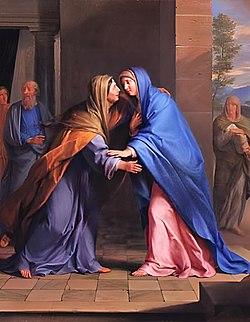
Elizabeth (left) visited by Mary, the Visitation, by Philippe de Champaigne
Righteous
Born
1st century BC Hebron
Died
1st century BC (or early AD) (probably Hebron)
Venerated in
Roman Catholic Church Eastern Orthodox Church Oriental Orthodox Church Anglican Church Lutheran Church Islam
Canonized
Pre-Congregation
Feast
November 5 (Roman Catholic, Lutheran) September 5 (Eastern Orthodox, Anglican)
Patronage
Pregnant women
Elizabeth, also spelled Elisabeth (Greek Ἐλισάβετ) or Elisheba (from the Hebrew אֱלִישֶׁבַע / אֱלִישָׁבַע "My God has sworn"; Standard Hebrew Elišévaʿ Elišávaʿ, Tiberian Hebrew ʾĔlîšéḇaʿ ʾĔlîšāḇaʿ; Arabic أليصابات, Alyassabat), was the mother of John the Baptist and the wife of Zechariah, according to the Gospel of Luke.
Contents
1Biblical narrative
2Apocrypha
3Sainthood
4Islamic view
5See also
6Notes and references
7External links
Biblical narrative
According to the Gospel of Luke, Elizabeth was "of the daughters of Aaron" (1:5). She and her husband Zachariah were "righteous before God, walking in all the commandments and ordinances of the Lord blameless" (1:6–7), but childless. While he was in the temple of the Lord (1:8–12), Zacharias was visited by the angel Gabriel:
But the angel said to him: “Do not be afraid, Zechariah; your wife Elizabeth will bear you a son, and you are to call him John. He will be a joy and delight to you, and many will rejoice because of his birth, for he will be great in the sight of the Lord. He is never to take wine or other fermented drink, and he will be filled with the Holy Spirit even before he is born.
— Luke 1:13–15
Zacharias doubted whereby he could know this since both he and his wife were old. The angel identified himself as Gabriel and told Zacharias that he would be "dumb, and not able to speak" until the words were fulfilled, because he did not believe. When the days of his ministry were complete, he returned to his house (Luke 1:16–23).
After this his wife Elizabeth became pregnant and for five months remained in seclusion. “The Lord has done this for me,” she said. “In these days he has shown his favor and taken away my disgrace among the people.”
— Luke 1:24–25
According to the account, the angel Gabriel was then sent to Nazareth in Galilee to her relative[Luke 1:36]Mary, a virgin, espoused to a man called Joseph, and informed her that she would conceive by the Holy Ghost and bring forth a son to be called Jesus. After she was also informed that her "relative Elizabeth" had begun her sixth month of pregnancy, she traveled to "Hebron, in the hill country of Judah",[1] to visit Elizabeth.(Luke 1:26–40)
When Elizabeth heard Mary’s greeting, the baby leaped in her womb, and Elizabeth was filled with the Holy Spirit. In a loud voice she exclaimed: “Blessed are you among women, and blessed is the child you will bear! But why am I so favored, that the mother of my Lord should come to me? As soon as the sound of your greeting reached my ears, the baby in my womb leaped for joy. Blessed is she who has believed that the Lord would fulfill his promises to her!”
— Luke 1:41–45
15th century depiction of the Nativity of St. John the Baptist, with Elizabeth on the left.
Matthew Henry comments, "Mary knew that Elizabeth was with child, but it does not appear that Elizabeth had been told any thing of her relative Mary's being designed for the mother of the Messiah; and therefore what knowledge she appears to have had of it must have come by a revelation, which would be a great encouragement to Mary."[2] After Mary heard Elizabeth's blessing, she spoke the words now known as the Magnificat (Luke 1:46–55).
Mary stayed with Elizabeth for about three months and then returned home. When it was time for Elizabeth to have her baby, she gave birth to a son. Her neighbors and relatives heard that the Lord had shown her great mercy, and they shared her joy. On the eighth day they came to circumcise the child, and they were going to name him after his father Zechariah, but his mother spoke up and said, “No! He is to be called John.” They said to her, “There is no one among your relatives who has that name.” Then they made signs to his father, to find out what he would like to name the child. He asked for a writing tablet, and to everyone’s astonishment he wrote, “His name is John.” Immediately his mouth was opened and his tongue set free, and he began to speak, praising God.
— Luke 1:56–64
That is the last mention of Elizabeth, who is not mentioned in any other chapter in the Bible. The chapter continues with the prophecy of Zacharias, (known as the Benedictus,) and ends with the note that John "grew, and became strong in spirit, and was in the deserts" until his ministry to Israel began; so it is unknown how long Elizabeth and her husband lived after that (Luke 1:65–80).
A traditional "tomb of Elizabeth" is shown in the Franciscan Monastery of Saint John in the Wilderness near Jerusalem.
Apocrypha
Elizabeth is mentioned in several books of the Apocrypha, most prominently in the Protevangelion of James, in which the birth of her son and the subsequent murder of her husband are chronicled.
Sainthood
Elizabeth is revered as a saint in the Roman Catholic Church on September 23 and in the Orthodox and Anglican traditions on September 5, on the same day with her husband Zacharias/Zechariah. She is commemorated as a matriarch in the Calendar of Saints (November 5) of the Lutheran Church–Missouri Synod and Zacharias is commemorated as a prophet.[3]
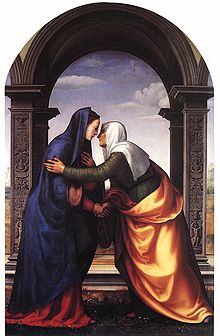
Mariotto Albertinelli's imagining of Elizabeth (right), here pictured with Mary
Islamic view
Elizabeth (Arabic: إليصابات, translit. ʾIlīṣābāt), the wife of Zachariah, the mother of John the Baptist and cousin[citation needed] of Mary, is an honored woman in Islam.[4] Although Zachariah himself is frequently mentioned by name in the Qur'an, Elizabeth, while not mentioned by name, is referenced. She is revered by Muslims as a wise, pious and believing person who, like her relative Mary, was exalted by God to a high station.[4] She lived in the household of Imran, and is said to have been a descendant of the prophet and priest Aaron.[5][relevant? – discuss]
Zachariah and his wife were both devout and steadfast in their duties. They were, however, both very old and they had no son. Therefore, Zachariah would frequently pray to God for a son.[6] This was not only out of the desire to have a son but also because the great Jesus Christ wanted someone to carry on the services of the Temple of prayer and to continue the preaching of the Lord's message before his death.
God cured Elizabeth's barrenness and granted Zachariah a son, Yahya (John the Baptist), who became a prophet.[7] God thus granted the wishes of the couple because of their faith, trust and love for God. In the Qur'an, God speaks of Zachariah, his wife and John describes the three as being humble servants of the LORD:
So We listened to him: and We granted him John: We cured his wife's (Barrenness) for him. These (three) were ever quick in emulation in good works; they used to call on Us with love and reverence, and humble themselves before Us.
— Qur'an, chapter 21 (Prophets), verse 90[8]
In Shia hadith she is named Hananah, and is identified as a sister of Mary's mother Hannah. Abu Basir recorded that Imam Ja'far al-Sadiq, the great grandson of the Islamic Prophet Muhammad, had stated "Hannah, the wife of Imran, and Hananah, the wife of Zechariah, were sisters. He goes on to say that Mary was born from Hannah and John was born from Hananah. Mary gave birth to Jesus and he was the son of the daughter of John's aunt. John was the son of the aunt of Mary, and the aunt of one's mother is like one's aunt."[9]
See also
Wikimedia Commons has media related to Saint Elisabeth.
Gospel of Luke
Visitation (Catholic feast)
Biblical figures in Islamic tradition
Notes and references
^Compare Luke 1:39–40 with Joshua 21:11 The Treasury of Scripture Knowledge says, "This was most probably Hebron, a city of the priests, and situated in the hill country of Judea, (Jos 11:21; 21:11, 13,) about 25 miles south of Jerusalem, and nearly 100 from Nazareth."
^Matthew Henry's Whole Bible Commentary Archived 2011-09-19 at the Wayback Machine
^Lutheran Book of Worship published by Augsburg Publishing House and the LCA Board of Publication, 1978. .mw-parser-output cite.citation{font-style:inherit}.mw-parser-output .citation q{quotes:"""""""'""'"}.mw-parser-output .citation .cs1-lock-free a{background:url("//upload.wikimedia.org/wikipedia/commons/thumb/6/65/Lock-green.svg/9px-Lock-green.svg.png")no-repeat;background-position:right .1em center}.mw-parser-output .citation .cs1-lock-limited a,.mw-parser-output .citation .cs1-lock-registration a{background:url("//upload.wikimedia.org/wikipedia/commons/thumb/d/d6/Lock-gray-alt-2.svg/9px-Lock-gray-alt-2.svg.png")no-repeat;background-position:right .1em center}.mw-parser-output .citation .cs1-lock-subscription a{background:url("//upload.wikimedia.org/wikipedia/commons/thumb/a/aa/Lock-red-alt-2.svg/9px-Lock-red-alt-2.svg.png")no-repeat;background-position:right .1em center}.mw-parser-output .cs1-subscription,.mw-parser-output .cs1-registration{color:#555}.mw-parser-output .cs1-subscription span,.mw-parser-output .cs1-registration span{border-bottom:1px dotted;cursor:help}.mw-parser-output .cs1-ws-icon a{background:url("//upload.wikimedia.org/wikipedia/commons/thumb/4/4c/Wikisource-logo.svg/12px-Wikisource-logo.svg.png")no-repeat;background-position:right .1em center}.mw-parser-output code.cs1-code{color:inherit;background:inherit;border:inherit;padding:inherit}.mw-parser-output .cs1-hidden-error{display:none;font-size:100%}.mw-parser-output .cs1-visible-error{font-size:100%}.mw-parser-output .cs1-maint{display:none;color:#33aa33;margin-left:0.3em}.mw-parser-output .cs1-subscription,.mw-parser-output .cs1-registration,.mw-parser-output .cs1-format{font-size:95%}.mw-parser-output .cs1-kern-left,.mw-parser-output .cs1-kern-wl-left{padding-left:0.2em}.mw-parser-output .cs1-kern-right,.mw-parser-output .cs1-kern-wl-right{padding-right:0.2em}
ISBN 0-8006-3330-X
^ abWomen in the Qur'ān, Traditions, and Interpretation. Oxford University Press. 1994. pp. 68–69.
^Luke 1:5: "There was in the days of Herod, the king of Judæa, a certain priest named Zacharias, of the course of Abia: and his wife [was] of the daughters of Aaron, and her name [was] Elizabeth."
^Quran 21:89: "And Zachariah, when he cried unto his Lord: My Lord! Leave me not childless, though Thou art the Best of inheritors."
^Quran 19:12: "(To his son came the command): 'O John! take hold of the Book with might': and We gave him Wisdom even as a youth,"
^Quran 21:90: "So We listened to him: and We granted him John: We cured his wife's (Barrenness) for him. These (three) were ever quick in emulation in good works; they used to call on Us with love and reverence, and humble themselves before Us."
^Muntazir Qa'im, Mahdi (2007). Jesus Through the Qur’an and Shi’ite Narrations (Bilingual ed.). Queens, New York: Tahrike Tarsile Qur'an. pp. 14–15. ISBN 978-1879402140.
External links
Stained glass depiction of Elizabeth and Zachary, Cathédrale Saint-Etienne de Bourges
Elizabeth (biblical figure)
Life of Jesus
Preceded by The Annunciation
New Testament Events
Succeeded by Birth of Jesus: The Nativity
v
t
e
Prophets in the New Testament
Canonical gospels
Anna
Elizabeth
Jesus
John the Baptist
Joseph
Mary
Simeon
Zechariah
Acts of the Apostles
Agabus
Ananias of Damascus
Barnabas
Judas Barsabbas
Lucius of Cyrene
Manahen
Paul
Philip the Evangelist
Silas
Simeon Niger
Epistles and Revelation
John of Patmos
The Two Witnesses
Note: Italics denote that the status as a prophet is not universally accepted.
‹ The template below (New Testament people) is being considered for merging. See templates for discussion to help reach a consensus. ›
v
t
e
New Testament people
Jesus Christ
In Christianity
Historical
Life of Jesus in the New Testament
Gospels
Individuals
Alphaeus
Anna the Prophetess
Annas
Barabbas
Bartimaeus
Blind man (Bethsaida)
Caiaphas
Celidonius
Cleopas
Clopas
Devil
Penitent thief ("Dismas")
Elizabeth
Gabriel
Impenitent thief ("Gestas")
Jairus' daughter
Joanna
John the Baptist
Joseph
Joseph of Arimathea
Joses
Jude
Lazarus
Legion
Luke
Lysanias
Malchus
Martha
Mary, mother of Jesus
Mary Magdalene
Mary, mother of James
Mary of Bethany
Mary of Clopas
Naked fugitive
Son of Nain's widow
Nathanael
Nicodemus (Nicodemus ben Gurion)
Salome
Samaritan woman
Satan
Simeon
Simon, brother of Jesus
Simon of Cyrene
Simon the Leper
Simon the Pharisee
Susanna
Syrophoenician woman
Theophilus
Zacchaeus
Zebedee
Zechariah
Groups
Angels
Jesus's brothers
Demons
Disciples
Evangelists
Female disciples of Jesus
God-fearers
Herodians
Magi
Myrrhbearers
Nameless
Pharisees
Proselytes
Sadducees
Samaritans
Sanhedrin
Scribes
Seventy disciples
Shepherds
Zealots
Apostles
Andrew
Bartholomew
James of Alphaeus (James the Less)
James of Zebedee
John
Evangelist
Patmos
"Disciple whom Jesus loved"
Judas Iscariot
Jude Thaddeus
Matthew
Philip
Simon Peter
Simon the Zealot
Thomas
Acts
Aeneas
Agabus
Ananias (Damascus)
Ananias (Judaea)
Ananias son of Nedebeus
Apollos
Aquila
Aristarchus
Barnabas
Blastus
Cornelius
Demetrius
Dionysius
Dorcas
Elymas
Egyptian
Ethiopian eunuch
Eutychus
Gamaliel
James, brother of Jesus
Jason
Joseph Barsabbas
Judas Barsabbas
Judas of Galilee
Lucius
Luke
Lydia
Manaen
(John) Mark
Evangelist
cousin of Barnabas
Mary, mother of (John) Mark
Matthias
Mnason
Nicanor
Nicholas
Parmenas
Paul
Philip
Priscilla
Prochorus
Publius
Rhoda
Sapphira
Sceva
Seven Deacons
Silas / Silvanus
Simeon Niger
Simon Magus
Sopater
Sosthenes
Stephen
Theudas
Timothy
Titus
Trophimus
Tychicus
Zenas
Romans Herod's family
Gospels
Antipas
Archelaus
Herod the Great
Herodias
Longinus
Philip
Pilate
Pilate's wife
Quirinius
Salome
Tiberius
Acts
Agrippa
Agrippa II
Berenice
Cornelius
Drusilla
Felix
Festus
Gallio
Lysias
Paullus
Epistles
Achaicus
Alexander
Andronicus
Archippus
Aretas IV
Carpus
Claudia
Crescens
Demas
Diotrephes
Epaphras
Epaphroditus
Erastus
Eunice
Euodia and Syntyche
Herodion
Hymenaeus
Jesus Justus
John the Presbyter
Junia
Lois
Mary
Michael
Nymphas
Olympas
Onesimus
Onesiphorus
Pudens
Philemon
Philetus
Phoebe
Quartus
Sosipater
Tertius
Revelation
Antipas
Four Horsemen
Apollyon
Two witnesses
Woman
Beast
Three Angels
Whore of Babylon
v
t
e
People and things in the Quran
Characters
Non-humans
Allāh ("The God")
Names of Allah found in the Quran, such as Karīm (Generous)
Beings in Paradise
Ghilmān or Wildān
Ḥūr
Animals
Related
The baqarah (cow) of Israelites
The dhi’b (wolf) that Jacob feared could attack Joseph
The fīl (elephant) of the Abyssinians)
Ḥimār (Domesticated donkey)
The hud-hud (hoopoe) of Solomon
The kalb (dog) of the sleepers of the cave
The namlah (female ant) of Solomon
The nūn (fish or whale) of Jonah
The nāqat (she-camel) of Saleh
Non-related
Dābbat al-Arḍ (Beast of the Earth)
Ḥimār (Wild ass)
Qaswarah ("Lion", "beast of prey" or "hunter")
Angels
Angels of Hell
Mālik
Zabāniyah
Angel of the Trumpet (Isrāfīl or Raphael)
Jibrīl (Gabriel)
Mīkāl (Michael)
‘Izrā’īl Malakul-Mawt (Azrael, Angel of Death)
Bearers of the Throne
Riḍwān
Munkar and Nakir
Harut and Marut
Kirāman Kātibīn (Honourable Scribes)
Raqib
Atid
Jinn
‘Ifrīt
Jann
Mārid ("Rebellious one")
Shayāṭīn (Demons)
Iblīs the (Chief) Shayṭān (Devil)
Qarīn
Prophets
Mentioned
Ādam (Adam)
Al-Yasa‘ (Elisha)
Ayyūb (Job)
Dāwūd (David)
Dhūl-Kifl (Ezekiel?)
Hārūn (Aaron)
Hūd (Eber?)
Idrīs (Enoch?)
Ilyās (Elijah)
‘Imrān (Joachim the father of Maryam)
Isḥāq (Isaac)
Ismā‘īl (Ishmael)
Dhabih Ullah
Isma'il Ṣādiq al-Wa‘d (Fulfiller of the Promise)
Lūṭ (Lot)
Ṣāliḥ
Shu‘ayb (Jethro, Reuel or Hobab?)
Sulaymān ibn Dāwūd (Solomon son of David)
‘Uzair (Ezra?)
Yaḥyā ibn Zakariyyā (John the Baptist the son of Zechariah)
Ya‘qūb (Jacob)
Isrā’īl (Israel)
Yūnus (Jonah)
Dhūn-Nūn ("He of the Fish (or Whale)" or "Owner of the Fish (or Whale)")
Ṣāḥib al-Ḥūt ("Companion of the Whale")
Yūsuf ibn Ya‘qūb (Joseph son of Jacob)
Zakariyyā (Zechariah)
Ulu-l-‘Azm
Muḥammad
Aḥmad
Other names and titles of Muhammad
ʿĪsā (Jesus)
Al-Masīḥ (The Messiah)
Ibn Maryam (Son of Mary)
Mūsā Kalīmullāh (Moses He who spoke to God)
Ibrāhīm Khalīlullāh (Abraham Friend of God)
Nūḥ (Noah)
Debatable ones
Dhūl-Qarnain
Luqmān
Maryam (Mary)
Ṭālūt (Saul or Gideon?)
Implied
Irmiyā (Jeremiah)
Ṣamū’īl (Samuel)
Yūsha‘ ibn Nūn (Joshua, companion and successor of Moses)
People of Prophets
Evil ones
Āzar (possibly Terah)
Fir‘awn (Pharaoh of Moses' time)
Hāmān
Jālūt (Goliath)
Qārūn (Korah, cousin of Moses)
As-Sāmirī
Abī Lahab
Slayers of Saleh's she-camel (Qaddar ibn Salif and Musda' ibn Dahr)
Good ones
Adam's immediate relatives
Martyred son
Wife
Believer of Ya-Sin
Family of Noah
Father Lamech
Mother Shamkhah bint Anush or Betenos
Luqman's son
People of Aaron and Moses
Believer of Fir'aun Family (Hizbil/Hizqil ibn Sabura)
Imra’at Fir‘awn (Āsiyá bint Muzāḥim or Pharaoh's daughter)
Khidr
Magicians of the Pharaoh
Moses' wife
Moses' sister-in-law
Mother
Sister
People of Abraham
Mother Abiona or Amtelai the daughter of Karnebo
Ishmael's mother
Isaac's mother
People of Jesus
Disciples (including Peter)
Mary's mother
Zechariah's wife
People of Joseph
Brothers (including Binyāmin (Benjamin) and Simeon)
Egyptians
‘Azīz (Potiphar, Qatafir or Qittin)
Malik (King Ar-Rayyān ibn Al-Walīd))
Wife of ‘Azīz (Zulaykhah)
Mother
People of Solomon
Mother
Queen of Sheba
Vizier
Zayd
Implied or not specified
Abrahah[clarification needed]
Bal'am/Balaam
Barsisa
Caleb or Kaleb the companion of Joshua
Luqman's son
Nebuchadnezzar II
Nimrod
Rahmah the wife of Ayyub
Shaddad
Groups
Mentioned
Aṣḥāb al-Jannah
People of Paradise
People of the Burnt Garden
Aṣḥāb as-Sabt (Companions of the Sabbath)
Christian apostles
Ḥawāriyyūn (Disciples of Jesus)
Companions of Noah's Ark
Aṣḥāb al-Kahf war-Raqīm (Companions of the Cave and Al-Raqaim?
Companions of the Elephant
People of al-Ukhdūd
People of a township in Surah Ya-Sin
People of Yathrib or Medina
Qawm Lūṭ (People of Sodom and Gomorrah)
Nation of Noah
Tribes, ethnicities or families
A‘rāb (Arabs or Bedouins)
ʿĀd (people of Hud)
Companions of the Rass
Qawm Tubba‘ (People of Tubba)
People of Saba’ or Sheba
Quraysh
Thamūd (people of Saleh)
Aṣḥāb al-Ḥijr ("Companions of the Stoneland")
‘Ajam
Ar-Rûm (literally "The Romans")
Banī Isrā’īl (Children of Israel)
Mu’tafikāt (The overthrown cities of Sodom and Gomorrah)
People of Ibrahim
People of Ilyas
People of Nuh
People of Shuaib
Ahl Madyan People of Madyan)
Aṣḥāb al-Aykah ("Companions of the Wood")
Qawm Yūnus (People of Jonah)
Ya'juj and Ma'juj/Gog and Magog
Ahl al-Bayt ("People of the Household")
Household of Abraham
Brothers of Yūsuf
Lot's daughters (Ritha, Za'ura, et al.)
Progeny of Imran
Household of Moses
Household of Muhammad ibn Abdullah ibn Abdul-Muttalib ibn Hashim
Daughters of Muhammad
Muhammad's wives
Household of Salih
People of Fir'aun
Current Ummah of Islam (Ummah of Muhammad)
Aṣḥāb Muḥammad (Companions of Muhammad)
Anṣār (Muslims of Medina who helped Muhammad and his Meccan followers, literally 'Helpers')
Muhajirun (Emigrants from Mecca to Medina)
People of Mecca
Umm Jamil (wife of Abu Lahab)
Children of Ayyub
Dead son of Sulaiman
Qabil/Cain (son of Adam)
Wali'ah or Wa'ilah/Waala (wife of Nuh)
Walihah or Wahilah (wife of Lut)
Ya’jūj wa Ma’jūj (Gog and Magog)
Yam or Kan'an (son of Nuh)
Implicitly mentioned
Amalek
Ahl as-Suffa (People of the Verandah)
Banu Nadir
Banu Qaynuqa
Banu Qurayza
Iranian people
Umayyad Dynasty
Aus and Khazraj
People of Quba
Religious groups
Ahl al-dhimmah (Dhimmi)
Kāfirūn (Infidels)
Zoroastrians
Munafiqun (Hypocrites)
Muslims
People of the Book (Ahl al-Kitāb)
Naṣārā (Christian(s) or People of the Injil)
Ruhban (Christian monks)
Qissis (Christian priest)
Yahūd (Jews)
Ahbār (Jewish scholars)
Rabbani/Rabbi
Sabians
Polytheists
Meccan polytheists at the time of Muhammad
Mesopotamian polytheists at the time of Abraham and Lot
Locations
Mentioned
Al-Arḍ Al-Muqaddasah ("The Holy Land")
'Blessed' Land
In the Arabian Peninsula (excluding Madyan)
Al-Aḥqāf ("The Sandy Plains," or "the Wind-curved Sand-hills")
Iram dhāt al-‘Imād (Iram of the Pillars)
Al-Madīnah (formerly Yathrib)
‘Arafāt
Al-Ḥijr (Hegra)
Badr
Ḥunayn
Makkah (Mecca)
Bakkah
Ḥaraman Āminan ("Sanctuary (which is) Secure")
Ka‘bah (Kaaba)
Maqām Ibrāhīm (Station of Abraham)
Safa and Marwa
Saba’ (Sheba)
‘Arim Saba’ (Dam of Sheba)
Rass
Al-Jannah (Paradise, literally "The Garden")
Jahannam (Hell)
In Mesopotamia:
Al-Jūdiyy
Munzalanm-Mubārakan ("Place-of-Landing Blessed")
Bābil (Babylon)
Qaryat Yūnus ("Township of Jonah," that is Nineveh)
Door of Hittah
Madyan (Midian)
Majma‘ al-Baḥrayn
Miṣr (Mainland Egypt)
Salsabīl (A river in Paradise)
Sinai Region or Tīh Desert
Al-Wād Al-Muqaddas Ṭuwan (The Holy Valley of Tuwa)
Al-Wādil-Ayman (The valley on the 'righthand' side of the Valley of Tuwa and Mount Sinai)
Mount Sinai or Mount Tabor
Religious locations
Bay'a (Church)
Miḥrāb
Monastery
Masjid (Mosque, literally "Place of Prostration")
Al-Mash‘ar Al-Ḥarām ("The Sacred Grove")
Al-Masjid Al-Aqṣā (Al-Aqsa Mosque, literally "The Farthest Place-of-Prostration")
Al-Masjid Al-Ḥarām (The Sacred Mosque of Mecca)
Masjid al-Dirar
A Mosque in the area of Medina, possibly:
Masjid Qubā’ (Quba Mosque)
The Prophet's Mosque
Salat (Synagogue)
Implied
Antioch
Antakya
Arabia
Ayla
Barrier of Dhul-Qarnayn
Bayt al-Muqaddas & 'Ariha
Bilād ar-Rāfidayn (Mesopotamia)
Canaan
Cave of Seven Sleepers
Dār an-Nadwa
Al-Ḥijāz (literally "The Barrier")
Black Stone (Al-Ḥajar al-Aswad) & Al-Hijr of Isma'il
Cave of Hira & Ghar al-Thawr (Cave of the Bull)
Ta'if
Hudaybiyyah
Jordan River
Nile River
Palestine River
Paradise of Shaddad
Plant matter
Baṣal (Onion)
Fūm (Garlic or wheat)
Shaṭ’ (Shoot)
Sūq (Plant stem)
Zar‘ (Seed)
Fruits
‘Adas (Lentil)
Baql (Herb)
Ḥabb dhul-‘aṣf (Corn of the husk)
Qith-thā’ (Cucumber)
Rummān (Pomegranate)
Tīn (Fig)
Ukul khamṭ (Bitter fruit or food of Sheba)
Zaytūn (Olive)
In Paradise
Forbidden fruit of Adam
Bushes, trees or plants
Plants of Sheba
Athl (Tamarisk)
Sidr (Lote-tree)
Līnah (Tender Palm tree)
Nakhl (Date palm)
Rayḥān (Scented plant)
Sidrat al-Muntahā
Zaqqūm
Holy books
Al-Injīl (The Gospel of Jesus)
Al-Qur’ān (The Book of Muhammad)
Ṣuḥuf-i Ibrāhīm (Scroll(s) of Abraham)
At-Tawrāt (The Torah)
Ṣuḥuf-i-Mūsā (Scroll(s) of Moses)
Tablets of Stone
Az-Zabūr (The Psalms of David)
Umm al-Kitāb ("Mother of the Book(s)")
Objects of people or beings
Heavenly Food of Christian Apostles
Noah's Ark
Staff of Musa
Tābūt as-Sakīnah (Casket of Shekhinah)
Throne of Bilqis
Trumpet of Israfil
Mentioned idols (cult images)
'Ansāb
Idols of Israelites:
Baal
The ‘ijl (golden calf statue) of Israelites
Idols of Noah's people:
Nasr
Suwā‘
Wadd
Yaghūth
Ya‘ūq
Idols of Quraysh:
Al-Lāt
Al-‘Uzzá
Manāt
Jibt and Ṭāghūt
Celestial bodies
Maṣābīḥ (literally 'lamps'):
Al-Qamar (The Moon)
Kawākib (Planets)
Al-Arḍ (The Earth)
Nujūm (Stars)
Ash-Shams (The Sun)
Liquids
Mā’ (Water or fluid)
Nahr (River)
Yamm (River or sea)
Sharāb (Drink)
Events, incidents, occasions or times
Incident of Ifk
Laylat al-Qadr
Event of Mubahala
Sayl al-‘Arim (Flood of the Great Dam of Marib in Sheba)
The Farewell Pilgrimage
Treaty of Hudaybiyyah
Battles or military expeditions
Battle of al-Aḥzāb ("the Confederates")
Battle of Badr
Battle of Hunayn
Battle of Khaybar
Battle of Tabouk
Battle of Uhud
Conquest of Mecca
Days
Al-Jumu‘ah (The Friday)
As-Sabt (The Sabbath or Saturday)
Days of battles
Days of Hajj
Doomsday
Months of the Islamic calendar
Four holy months
Ramaḍān
Pilgrimages
Al-Ḥajj (literally "The Pilgrimage", the Greater Pilgrimage)
Al-‘Umrah (The Lesser Pilgrimage)
Times for Prayer or Remembrance
Times for Duʿāʾ ('Invocation'), Ṣalāh and Dhikr ('Remembrance', including Taḥmīd ('Praising'), Takbīr and Tasbīḥ):
Al-‘Ashiyy (The Afternoon or the Night)
Al-Ghuduww ("The Mornings")
Al-Bukrah ("The Morning")
Aṣ-Ṣabāḥ ("The Morning")
Al-Layl ("The Night")
Al-‘Ishā’ ("The Late-Night")
Aẓ-Ẓuhr ("The Noon")
Dulūk ash-Shams ("Decline of the Sun")
Al-Masā’ ("The Evening")
Qabl al-Ghurūb ("Before the Setting (of the Sun)")
Al-Aṣīl ("The Afternoon")
Al-Aṣr ("The Afternoon")
Qabl ṭulū‘ ash-Shams ("Before the rising of the Sun")
Al-Fajr ("The Dawn")
Implied
Event of Ghadir Khumm
Laylat al-Mabit
The first pilgrimage
Note: The names are sorted alphabetically. Standard form: Islamic name / Biblical name (title or relationship)
.everyoneloves__top-leaderboard:empty,.everyoneloves__mid-leaderboard:empty,.everyoneloves__bot-mid-leaderboard:empty{ height:90px;width:728px;box-sizing:border-box;
}
0
I am uploading my code to heroku with the command: git push heroku master But whenever i push the code, whole code pushed on the server, but there is nothing there but application error. 2018-11-17T07:14:17.465955+00:00 heroku[router]: at=error code=H10 desc="App crashed" method=GET path="/" host=ecodrivebot.herokuapp.com request_id=47dc6aff-19dc-45e3-8a86-2d41eeef86b0 fwd="122.180.29.179" dyno= connect= service= status=503 bytes= protocol=https 2018-11-17T07:14:18.030853+00:00 heroku[router]: at=error code=H10 desc="App crashed" method=GET path="/favicon.ico" host=ecodrive...
Thiostrepton [1] Names Other names Alaninamide, Bryamycin, Thiactin Identifiers CAS Number 1393-48-2 Y 3D model (JSmol) Interactive image ChEMBL ChEMBL468719 N ECHA InfoCard 100.014.304 PubChem CID 16130278 InChI InChI=1S/C72H85N19O18S5/c1-14-26(3)47-63(105)78-30(7)57(99)75-28(5)56(98)76-31(8)58(100)91-72-19-18-40(66-85-43(22-111-66)59(101)77-29(6)55(97)74-27(4)54(73)96)81-52(72)42-21-112-67(83-42)49(34(11)109-69(107)41-20-37(32(9)92)36-16-17-39(79-47)51(95)50(36)80-41)89-60(102)44-24-113-68(86-44)53(71(13,108)35(12)94)90-62(104)45-23-110-65(84-45)38(15-2)82-64(106)48(33(10)93)88-61(103)46-25-114-70(72)87-46/h15-17,20-22,24-26,30-35,39,45,47-49,51-53,79,92-95,108H,4-6,14,18-19,23H2,1-3,7-13H3,(H2,73,96)(H,74,97)(H,75,99)(H,76,98)(H,77,101)(H,78,105)(H,82,106)(H,88,103)(H,89,102)(H,90,104)(H,91,100)/b38-15-/t26-,30-,31-,32-,33+,34+,35+,39+,45+,47-,48-,49-,51-,52+,53+,71+,72+/m0/s1 Key: NSFFHOGKXHRQEW-AIHSUZKVSA-N ...
Jo Brand Brand at the BBC Magazines Awards for Excellence, 2007 Birth name Josephine Grace Brand Born ( 1957-07-23 ) 23 July 1957 (age 61) Hastings, East Sussex, England Medium Stand-up Television Film Nationality British Years active 1986–present Genres Observational Alternative Subject(s) Marriage Politics Spouse Bernie Bourke (m. 1997) Children 2 Josephine Grace Brand (born 23 July 1957) [1] is an English comedian, writer and actress. [2] Starting her entertainment career with a move from psychiatric nursing to the alternative comedy stand-up scene and early performances on Saturday Live , she went on to appear on The Brain Drain , Channel 4's Jo Brand Through the Cakehole , Getting On and various television appearances including as a regular guest on QI , Have I Got News for You and Would I Lie to You? . She is currently the presenter of The Great British Bake Off: An Extra Slice . In 2003, Brand was listed i...


 Category
 Saints Portal


