Bubastite Portal
Coordinates: 25°43′07″N 32°39′27″E / 25.71874°N 32.6574°E / 25.71874; 32.6574

The temple wall depicts a list of city states conquered by Shoshenq I in his Near Eastern military campaigns.
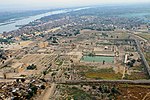
The Bubastite Portal gate is located in Karnak, within the Precinct of Amun-Re temple complex, between the temple of Ramesses III and the second pylon. It records the conquests and military campaigns in c.925 BCE of Shoshenq I, of the Twenty-second Dynasty.[1] Shoshenq has been identified with the biblical Shishaq, such that the relief is also known as the Shishak Inscription or Shishaq Relief.[2]
Contents
1 History
2 Description
3 Transliterations and translations
3.1 Section One
3.2 Section Two - Coastal plain, Shephelah, Meggido plain and Jezreel plain
3.3 Section Three - Negev area
4 Biblical narrative
5 See also
6 External links
7 References
History

Champollion's 1829 drawing of a cartouche showing the name "ydhmrk". Champollion's 1829 read of this name as "King of Judah" has been discredited by modern scholars, who generally accept that the phrase refers to "Yad Hemmelek" ("Hand of the King"), although it has also been interpreted as "Juttah of the King"[3]
This gate was erected by the kings of the Twenty-second Dynasty of Egypt, also known as the "Bubastite Dynasty". It is located to the south-east side of the Temple of Ramesses III.
Although Karnak had been known to Europeans since the end of the Middle Ages, the possible significance of the Bubastite Portal was not apparent prior to the decipherment of hieroglyphics. Jean-François Champollion visited Karnak in 1828, six years after his publication of the Rosetta Stone translation. In his letters he wrote:
.mw-parser-output .templatequote{overflow:hidden;margin:1em 0;padding:0 40px}.mw-parser-output .templatequote .templatequotecite{line-height:1.5em;text-align:left;padding-left:1.6em;margin-top:0}
In this wonderful palace, I observed the portraits of most of the old Pharaohs known for their great deeds.... we see people fighting enemies Mandoueï of Egypt, and returning in triumph to his homeland, farther campaigns Ramses-Sesostris also Sésonchis dragging the foot of the Theban Triad (Amun, Mut and Khonsu) defeating thirty conquered nations, among which I found, as it should be, in full, Ioudahamalek, the kingdom of Judah, or the Jews. This matches the commentary in 1 Kings 14, which recounts the successful arrival of Sésonchis at Jerusalem: the identity that we have established between the Egyptian Sheschonck the Sésonchis of Manetho and Scheschôk or Shishak of the Bible, is confirmed in the most satisfactory manner.
— Jean-François Champollion, Lettres ecrites d'Egypte et de Nubie en 1828 et 1829[4]
Description

Portal showing cartouches of Sheshonq I
One facade shows King Sheshonq I, Teklot and Osorkon of the 22nd dynasty, making offerings to the gods and goddesses. Another scene shows Sheshonq grasping a group of captives by the hair and smiting them by his mace. Behind and below him, there are the names of Canaanite towns in several rows. Many of these are lost, but originally there were 156 names and one of the most interesting names which were mentioned is 'The Field of Abram' . The inscriptions give no details for this expedition and mentioned only the victory over the Asiatics.
Transliterations and translations
Below is a translation of the 156 names on the inscription.[5]
Section One
Row I - Listing of the Nine Bows
1. tirsy- Southern Land (i.e. Upper Egypt)
2. ti mhw = Northern Land (i.e. Lower Egypt)
3. iwn.tiw = Tribesmen
4. thnw = Libyans
5. sht[-iimw - Sekhet[-Iam]
6. mn[.tiw] = Beduin
7. pd[.tiwswi= Bow[men of the feather]
8. Sit = Upper Nubia
9. /tf[.wwi]<b.w = Northerners
Section Two - Coastal plain, Shephelah, Meggido plain and Jezreel plain
10. mi.ti Tr.f] = Copy of the [scroll]
11. St 1
12. m[ ]i = Makkedah
13. rbt = Rubate
Row II
14. r<7i*/ = Ta'anach
15. Snmi = Shunem
16. btSnri = Beth-Shean
17. r#H = Rehob
18. hprmi = Hapharaim
19. idrm = Adoraim [6]
20. destroyed
21. Swd
22. mhnm - Mahanaim
23. <7&<7i = Gibeon
24. bthwrn = Beth-Horon
25. qdtm = Kiriath-jearim or Gath-Gittaim
26. iywrn = Aijalon
Row III
27. mkdi = Megiddo
28. Wr = Adar
29. ydhmrk = Yad Hammelek
30. [ ]rr
31. hinm = Henam
32. c rn = Aruna
33. brm = Borim
34. ddptr = Giti-Padalla
35. yhm = Yehem
36. bfrm = Beth 'Olam
37. kqr
38. £/* = Socoh
39. bttp = Beth-Tappuah
Row IV
40. ibri
41. [ ]htp
42. destroyed
43. destroyed
44. destroyed
45. btdb[ ]
46. nbk[ ]
47. [ ]/[ ]
48. destroyed
49. destroyed
50. destroyed
51. [ ssd[
52. destroyed
Row V
53. [p]nir = Penuel
54. hdSt
55. pktt / pi-wr-ktt
56. idmi = Adam
57. dmrm = Zemaraim
58. [ ]</r = Migdol
59. [ ]/tf/ = Tirzah
60. [ ]/ir
61. [ l/
62. destroyed
63. destroyed
64. [ ]#m
65. pi- r mq = The Valley
Section Three - Negev area
Row VI
66. r W/ = Ezem / Umm el-Azam
67. inr
68. pihqri = the fort
69. ftiSi = Photis
70. irhrr = Jehallel / El-Hallal
71. plhqri
72. ibrm
73. Sbrt = stream
74. ngbry = of (Ezion-)Geber
75. Sbrt = stream
76. wrkt
77. pihqri
78. n c dyt
79. dd[ ]/
80. dpqi = Sapek
81. m[Vl 1
82. tp[ ]
Row VII
83. gnit
84. /?4ng6 = TheNegev
85. r dht
86. tSdnw
87. pi hqr[t]
88. Snyi
89. he/
90. pi ng[b] = The Neg[ev]
91. whtwrk[ ]
92. pi ngb = The Negev
93. tfM'l
94. plhgri
95. hnnl
96. pihgri
97. irqd = El-Gad
98. [idmmt
99. hnni
Row VIII
100. Wr/ = Adar
101. plhgri
102. [trw]n
103. hydbi
104. 5rnrm
105. [ ]y[ ]
106. dwt
107. hqrm
108. r rd/r = Arad
109. [rbt] = Great
110. r r<// = Arad
111. nbtr
112. yrhm = Yeroham
113. [ 1/
114. destroyed
115. destroyed
116. /rf[r]/
Row IX
117. [idr ]
118. [bi
119. [M
120. [ ]ryk
121. frtmi = Peleth
122. ibr
123. brrd
124. bfnt = Beth-Anath
125. Srhn = Sharuhen
126. irmtn = El-mattan
127. g/ri = Goren
128. idmm
129. [ lr/j/
130. [ ]r
131. mr[ ]
132. irr[ ]
133. yd 1
Row X
134. destroyed
135. destroyed
136. destroyed
137. destroyed
138. destroyed
139. yrhm = Yehoram
140. /<rt = Onam
141. destroyed
142. [ ]g[ ]
143. destroyed
144. destroyed
145. m[k ]
146. id[r ]
147. destroyed
148. destroyed
149. [ ]3
150. yrdn
Row X extension
la. Srdd
2a. rph = Raphiah
3a. r&n = Laban
4a. c ngrn
5a. hm
Biblical narrative
The Biblical narrative recounts:
In the fifth year of King Rehoboam, because they had been unfaithful to the LORD, Shishaq king of Egypt came up against Jerusalem with 1,200 chariots and 60,000 horsemen. And the people were without number who came with him from Egypt— Libyans, Sukkiim, and Ethiopians. And he took the fortified cities of Judah and came as far as Jerusalem. Then Shemaiah the prophet came to Rehoboam and to the princes of Judah, who had gathered at Jerusalem because of Shishak, and said to them, "Thus says the LORD, 'You abandoned me, so I have abandoned you to the hand of Shishaq.'" Then the princes of Israel and the king humbled themselves and said, "The LORD is righteous." When the LORD saw that they humbled themselves, the word of the LORD came to Shemaiah: "They have humbled themselves. I will not destroy them, but I will grant them some deliverance, and my wrath shall not be poured out on Jerusalem by the hand of Shishaq. Nevertheless, they shall be servants to him, that they may know my service and the service of the kingdoms of the countries."
So Shishaq king of Egypt came up against Jerusalem. He took away the treasures of the house of the LORD and the treasures of the king’s house. He took away everything. He also took away the shields of gold that Solomon had made, and King Rehoboam made in their place shields of bronze and committed them to the hands of the officers of the guard, who kept the door of the king’s house. And as often as the king went into the house of the LORD, the guard came and carried them and brought them back to the guardroom. And when he humbled himself the wrath of the LORD turned from him, so as not to make a complete destruction. Moreover, conditions were good in Judah.
[7]
The account of Shishak carrying off treasures from Jerusalem is thought by some scholars to be of dubious historicity;[8]:175 see Shishak § Biblical narrative.
See also
- List of artifacts significant to the Bible
External links
- Kevin A. Wilson....... The Campaign Of Pharaoh Shoshenq I Into Palestine
- University of Chicago Oriental Institute Epigraphic Survey (1954), Reliefs and inscriptions at Karnak: The Bubastite portal, vol. III. Chicago: University of Chicago Press.
References
^ "Archived copy". Archived from the original on 2012-02-04. Retrieved 2012-09-30.CS1 maint: Archived copy as title (link).mw-parser-output cite.citation{font-style:inherit}.mw-parser-output .citation q{quotes:"""""""'""'"}.mw-parser-output .citation .cs1-lock-free a{background:url("//upload.wikimedia.org/wikipedia/commons/thumb/6/65/Lock-green.svg/9px-Lock-green.svg.png")no-repeat;background-position:right .1em center}.mw-parser-output .citation .cs1-lock-limited a,.mw-parser-output .citation .cs1-lock-registration a{background:url("//upload.wikimedia.org/wikipedia/commons/thumb/d/d6/Lock-gray-alt-2.svg/9px-Lock-gray-alt-2.svg.png")no-repeat;background-position:right .1em center}.mw-parser-output .citation .cs1-lock-subscription a{background:url("//upload.wikimedia.org/wikipedia/commons/thumb/a/aa/Lock-red-alt-2.svg/9px-Lock-red-alt-2.svg.png")no-repeat;background-position:right .1em center}.mw-parser-output .cs1-subscription,.mw-parser-output .cs1-registration{color:#555}.mw-parser-output .cs1-subscription span,.mw-parser-output .cs1-registration span{border-bottom:1px dotted;cursor:help}.mw-parser-output .cs1-ws-icon a{background:url("//upload.wikimedia.org/wikipedia/commons/thumb/4/4c/Wikisource-logo.svg/12px-Wikisource-logo.svg.png")no-repeat;background-position:right .1em center}.mw-parser-output code.cs1-code{color:inherit;background:inherit;border:inherit;padding:inherit}.mw-parser-output .cs1-hidden-error{display:none;font-size:100%}.mw-parser-output .cs1-visible-error{font-size:100%}.mw-parser-output .cs1-maint{display:none;color:#33aa33;margin-left:0.3em}.mw-parser-output .cs1-subscription,.mw-parser-output .cs1-registration,.mw-parser-output .cs1-format{font-size:95%}.mw-parser-output .cs1-kern-left,.mw-parser-output .cs1-kern-wl-left{padding-left:0.2em}.mw-parser-output .cs1-kern-right,.mw-parser-output .cs1-kern-wl-right{padding-right:0.2em}
^ http://cojs.org/cojswiki/Relief_and_Stelae_of_Pharaoh_Shoshenq_I:_Rehoboam’s_Tribute,_c._925_BCE[permanent dead link]
^ Kevin A. Wilson (2001). The Campaign of Pharaoh Shoshenq I Into Palestine. UMI. pp. 162–163.
^ Lettres ecrites d'Egypte et de Nubie en 1828 et 1829 In the original French: "Dans ce palais merveilleux, j'ai contemplé les portraits de la plupart des vieux Pharaons connus par leurs grandes actions, et ce sont des portraits véritables; représentés cent fois dans les bas-reliefs des murs intérieurs et extérieurs, chacun conserve une physionomie propre et qui n'a aucun rapport avec celle de ses prédécesseurs ou successeurs; là, dans des tableaux colossals, d'une sculpture véritablement grande et tout héroïque, plus parfaite qu'on ne peut le croire en Europe, on voit Mandoueï combattant les peuples ennemis de l'Égypte, et rentrant en triomphateur dans sa patrie; plus loin, les campagnes de Rhamsès-Sésostris; ailleurs, Sésonchis traînant aux pieds de la Trinité thébaine (Ammon, Mouth et Khons) les chefs de plus de trente nations vaincues, parmi lesquelles j'ai retrouvé, comme cela devait être, en toutes lettres, Ioudahamalek, le royaume des Juifs ou de Juda (Pl. 2.) C'est là un commentaire à joindre au chapitre XIV du troisième livre des Rois, qui raconte en effet l'arrivée de Sésonchis à Jérusalem et ses succès: ainsi l'identité que nous avons établie entre le Sheschonck égyptien, le Sésonchis de Manéthon et le Sésac ou Scheschôk de la Bible, est confirmée de la manière la plus satisfaisante. J'ai trouvé autour des palais de Karnac une foule d'édifices de toutes les époques, et lorsque, au retour de la seconde cataracte vers laquelle je fais voile demain, je viendrai m'établir pour cinq ou six mois à Thèbes, je m'attends à une récolte immense de faits historiques, puisque, en courant Thèbes comme je l'ai fait pendant quatre jours, sans voir même un seul des milliers d'hypogées qui criblent la montagne libyque, j'ai déjà recueilli des documents fort importants."
^ Kevin A. Wilson (2001). The Campaign of Pharaoh Shoshenq I Into Palestine. UMI.
^ Junkkaala, Eero. "Three conquests of Canaan: a comparative study of two Egyptian military campaigns and Joshua 10-12 in the light of recent archaeological evidence." (2006).
^ modified[clarification needed] after http://www.biblegateway.com/passage/?search=2%20Chronicles%2010-12;&version=47;
^ Finkelstein, Israel (2006). "The Last Labayu: King Saul and the Expansion of the First North Israelite Territorial Entity". In Amit, Yairah; Ben Zvi, Ehud; Finkelstein, Israel; et al. Essays on Ancient Israel in Its Near Eastern Context: A Tribute to Nadav Naʼaman. Eisenbrauns. pp. 171 ff. ISBN 9781575061283.
Karnak | |||||||
|---|---|---|---|---|---|---|---|
| General |
|  | |||||
| Precincts |
| ||||||
| Aten Temple |
| ||||||
| Related |
| ||||||


