Stock Car Brasil
| Category | Touring cars |
|---|---|
| Country | Brazil |
| Inaugural season | 1979 |
| Drivers | 33 (2018) |
| Teams | 17 (2018) |
| Constructors | Chevrolet |
| Tyre suppliers | Pirelli |
| Drivers' champion | Daniel Serra |
| Teams' champion | Eurofarma RC |
| Official website | www.stockcar.com.br |
 Current season Current season | |

Stock Car Brazil, 2006.
Stock Car Brasil, also known as Stock Car V8, is a touring car auto racing series based in Brazil. It is considered the major South American motorsports series.
Contents
1 History
1.1 1970s
1.2 1980s
1.3 1990s
1.4 2000s
1.5 2010s
2 Support races
3 Manufacturer representation
4 Scoring systems
5 Speed records
6 Drivers
6.1 Notable drivers
6.2 Former Formula One drivers
7 Champions
8 Circuits
9 Fatal accidents
10 See also
11 References
12 External links
History
1970s
The series was created in 1979 to be an alternative to the former Division 1 championship that competed with Chevrolet Opala and Ford Maverick. The dominance of Chevrolet over Ford models was causing a lack of public interest and sponsors. General Motors then created a new category, with a name reminiscent of the famous NASCAR with standardized performance and improvements for all the competitors. The first race was run on 22 April 1979 at the Autódromo Internacional de Tarumã, Rio Grande do Sul with 19 cars competing, all of them 6-cylinder Chevrolet Opalas. The pole position was held by José Carlos Palhares, and the race was won by Affonso Giaffone.
1980s
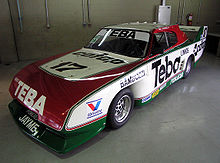
Chevrolet Opala 1987–1989
This decade saw the emergence of several rivalries between drivers. In 1982 two races were held for the first time at the Autodromo do Estoril, Portugal.
The first major change in the Stock Car standard occurred in 1987. With the support of General Motors, a fairing designed and built by coachbuilder Caio was adopted, which was adapted to the Opala's chassis. The car exhibited improved aerodynamics and performance. Safety equipment become more sophisticated.
1990s

Chevrolet Opala 1990–1993

Chevrolet Omega 1994–1999.
In 1990 General Motors renewed its interest in the category and built a prototype intended to replace the Caio/Hidroplas model.
In 1991 new rules were established and the races were disputed in double rounds on the weekends, with two drivers per car, but the series continued to lose ground with the public, sponsors and television networks to other championships with many manufacturers involved, such as Campeonato Brasileiro de Marcas e Pilotos that included the involvement of Chevrolet, Fiat, Ford and Volkswagen, as well as the always popular Formula racing championships.
In 1994 the championship returned to the old rules and Chevrolet announced that the Chevrolet Omega would be introduced as the new standard model. As part of a marketing strategy and in order to reduce costs, the tickets were free and the races were now held in double rounds sponsored by Brazilian Formula Chevrolet in an event called Chevrolet Challenger. This decade marked a dominant era for Ingo Hoffmann with eight titles, three in partnership with Ângelo Giombell. His only serious challenges came from Paulo Gomes in 1995 and Chico Serra in 1999.
2000s

Stock Car in 2007. Chassis used in 2000 until 2008.

JL G-09 Chevrolet 2009–2012
From 2000 on, General Motors departed the series and Vicar Promoções Desportivas, owned by former racing driver Carlos Col, took over the organization. This ushered in a period of modernization and improved security as the category started to use a tubular chassis designated JL G-09. The project engineer was Edgardo Fernandez, who did something similar for the Argentina category Top Race V6, inspired by both NASCAR and the DTM. The chassis was built by Zeca Giaffone's JL Racing.
In 2003 the category replaced the Chevrolet 6-cylinder engine used with modifications since 1979 with a Chevrolet V8 imported from the United States by JL Racing, similar to the engines used by the NASCAR Busch Series. General Motors participated in the series with the Vectra.
In 2005 Mitsubishi entered the series with the Mitsubishi Lancer. 30 October of that same year marked the first race held in Argentina at Autódromo Juan y Oscar Gálvez, alongside the TC 2000 category. Attendance was 70,000. Giuliano Losacco was the winner, with Mateus Greipel second and Luciano Burti coming in third.
In 2006, Volkswagen entered in the series with the Bora and the championship adopted a point system similar to the one used in NASCAR, as well as a new system with 16 teams and 32 drivers. At the end of the season, the 10 best drivers were automatically qualified to run the 4 final races, called Super Final, similar to the Chase for the Sprint Cup. In 2007, the category gained another manufacturer with the entrance of Peugeot with its 307 Sedan. Volkswagen announced it was withdrawing from the category in 2008, with two-time champion Mitsubishi doing the same one year later.
2010s

Alceu Feldmann on Campo Grande Speedway with the Chevrolet Vectra, in 2011.

Luciano Burti on Campo Grande Speedway with the Peugeot 408, in 2011.
For 2010 the category will use ethanol as fuel and engines with electronic injection.
In 2011, Peugeot re-entered the championship announced with the 408 sedan model, replacing the 307. In 2012, Chevrolet introduced the Chevrolet Sonic as its competing model. The category announced changes for 2012 season, dropping the Super Final system. The scoring system was also changed, with the top twenty drivers in each race being awarded points. For the 2016 season, General Motors announced the Chevrolet Cruze as the replacement for the Sonic. In 2017, Peugeot announced its retirement from the competition leaving Chevrolet as the lone automaker to compete in the series in which all drivers now use identical Cruze models, making it a one-make style championship in South American stock car racing.
Support races
Created in 1992, the Brazilian Formula Chevrolet was the Series' main support category. It used the same chassis as Formula Opel until 1994, subsequently switching to a Techspeed chassis until 2002, which was the same year the category was retired.
The Stock Car Light second tier was created in 1993, and reformulated in 2008 to become the Copa Vicar. After a merger with Pick-up Racing Brasil, the Copa Chevrolet Montana was established and standardized around the Chevrolet Montana model. Pick-up Racing Brasil was a category created in 2001 but only became part of the Stock Car Brasil programme until 2006.
The Stock Car Jr. third tier was created in 2006. It was intended for young and amateur drivers moving from Kart racing. In 2010 the category was replaced with the Mini Challenge Brasil. After three seasons it was cancelled.
Manufacturer representation
| Make | 79 | 80 | 81 | 82 | 83 | 84 | 85 | 86 | 87 | 88 | 89 | 90 | 91 | 92 | 93 | 94 | 95 | 96 | 97 | 98 | 99 | 00 | 01 | 02 | 03 | 04 | 05 | 06 | 07 | 08 | 09 | 10 | 11 | 12 | 13 | 14 | 15 | |
|---|---|---|---|---|---|---|---|---|---|---|---|---|---|---|---|---|---|---|---|---|---|---|---|---|---|---|---|---|---|---|---|---|---|---|---|---|---|---|
Chevrolet | Opala | Caio/Hidroplas | Opala Prototype | Omega | Vectra | Astra | Vectra | Sonic | ||||||||||||||||||||||||||||||
Mitsubishi | Lancer Evolution | |||||||||||||||||||||||||||||||||||||
Peugeot | 307 | 408 | ||||||||||||||||||||||||||||||||||||
Volkswagen | Bora | |||||||||||||||||||||||||||||||||||||
Scoring systems
| Race | ||||||||||||||||||||
|---|---|---|---|---|---|---|---|---|---|---|---|---|---|---|---|---|---|---|---|---|
| Position | 1st | 2nd | 3rd | 4th | 5th | 6th | 7th | 8th | 9th | 10th | 11th | 12th | 13th | 14th | 15th | 16th | 17th | 18th | 19th | 20th |
| Points | 22 | 20 | 18 | 17 | 16 | 15 | 14 | 13 | 12 | 11 | 10 | 9 | 8 | 7 | 6 | 5 | 4 | 3 | 2 | 1 |
Speed records

Bueno after running on the Bonneville Salt Flats.
| Year | Driver | Car | Local | Speed |
|---|---|---|---|---|
| 1991 | Fábio Sotto Mayor | Chevrolet Opala | Rodovia Rio-Santos | 303 km/h / 188 mph |
| 2010 | Cacá Bueno | Chevrolet Vectra JL G-09 | Bonneville Salt Flats[1] | 345 km/h / 214 mph |
Drivers
Notable drivers

Ingo Hoffmann, 12-times champion.
Affonso Giaffone Filho (1979–1980s) – The winner of the first race in 1979, and the champion of the 1981 season. The father of Affonso Giaffone, a former IndyCar Series driver.
Paulo Gomes (1979–2003/2007) – The winner of the first season in 1979, also 4-time champion.
Chico Serra (1999–2009) – 3-time champion (1999, 2000 and 2001)
Ingo Hoffmann (1979–2008) – 12-time champion (1980, 1985, 1989, 1990, 1991, 1992, 1993, 1994, 1996, 1997, 1998 and 2002) and the driver with the most series wins overall. He competed from 1979 to 2008.
Cacá Bueno (2002–) – 5-time Champion: (2006, 2007, 2009, 2011 and 2012). Runner-up: 2003, 2004 and 2005. He is the son of the sports commentator Galvão Bueno.
Former Formula One drivers
- Currently in the series
Luciano Burti (2005–)
Antônio Pizzonia (2007–)
Ricardo Zonta (2007–)
Rubens Barrichello (2012–)
- Formerly in the series
Ingo Hoffmann (1979–2008)
Raul Boesel (1979, 2003–2005)
Chico Serra (1980s – 2007 / 2009)
Tarso Marques (2005–2011)
Roberto Moreno (2005)
Jacques Villeneuve (2011)
Alex Ribeiro (1980s)
Wilson Fittipaldi (1980s – early 1990s)
Christian Fittipaldi (2005–2007 / 2010)
Enrique Bernoldi (2007 / 2009)
Esteban Tuero (2005)
Luiz Bueno (1982)
Bruno Senna (2013)
Champions
All champions are Brazilian-registered.
| Season | Driver | Car | Team |
|---|---|---|---|
1979 | Paulo Gomes | Chevrolet Opala | Coca-Cola Polwax |
1980 | Ingo Hoffmann | Chevrolet Opala | Johnson |
1981 | Affonso Giaffone Filho | Chevrolet Opala | Giaffone Motorsport |
1982 | Alencar Jr. | Chevrolet Opala | Jobi |
1983 | Paulo Gomes | Chevrolet Opala | Coca-Cola Polwax |
1984 | Paulo Gomes | Chevrolet Opala | Metalpó |
1985 | Ingo Hoffmann | Chevrolet Opala | Irmãos Giustino |
1986 | Marcos Gracia | Chevrolet Opala | Havoline-Texaco |
1987 | Zeca Giaffone | Chevrolet Opala | Refricentro/Blindex/Losacco |
1988 | Fábio Sotto Mayor | Chevrolet Opala | HG Rodão |
1989 | Ingo Hoffmann | Chevrolet Opala | Teba/Cofap |
1990 | Ingo Hoffmann | Chevrolet Opala | Teba/Arteb |
1991 | Ingo Hoffmann Ângelo Giombelli | Chevrolet Opala | Teba/Arteb |
1992 | Ingo Hoffmann Ângelo Giombelli | Chevrolet Opala | Castrol/Giombelli |
1993 | Ingo Hoffmann Ângelo Giombelli | Chevrolet Opala | Castrol/Giombelli |
1994 | Ingo Hoffmann | Chevrolet Omega | Castrol |
1995 | Paulo Gomes | Chevrolet Omega | Freio Vargas/JF |
1996 | Ingo Hoffmann | Chevrolet Omega | Castrol/Action Power |
1997 | Ingo Hoffmann | Chevrolet Omega | Castrol/Action Power |
1998 | Ingo Hoffmann | Chevrolet Omega | Castrol/Action Power |
1999 | Chico Serra | Chevrolet Vectra | Havoline-Texaco |
2000 | Chico Serra | Chevrolet Vectra | Havoline-Texaco |
2001 | Chico Serra | Chevrolet Vectra | Havoline-Texaco |
2002 | Ingo Hoffmann | Chevrolet Vectra | Filipaper/JF |
2003 | David Muffato | Chevrolet Vectra | Repsol-Boettger |
2004 | Giuliano Losacco | Chevrolet Astra | ItuPetro RC |
2005 | Giuliano Losacco | Chevrolet Astra | Medley-A.Mattheis |
2006 | Cacá Bueno | Mitsubishi Lancer | Eurofarma RC |
2007 | Cacá Bueno | Mitsubishi Lancer | Eurofarma RC |
2008 | Ricardo Maurício | Peugeot 307 | Medley-WA Mattheis |
2009 | Cacá Bueno | Peugeot 307 | Red Bull Racing |
2010 | Max Wilson | Chevrolet Vectra | Eurofarma RC |
2011 | Cacá Bueno | Peugeot 408 | Red Bull Racing |
2012 | Cacá Bueno | Chevrolet Sonic | Red Bull Racing |
2013 | Ricardo Maurício | Chevrolet Sonic | Eurofarma RC |
2014 | Rubens Barrichello | Chevrolet Sonic | Full Time Sports |
2015 | Marcos Gomes | Peugeot 408 | Voxx Racing |
2016 | Felipe Fraga | Peugeot 408 | Cimed Racing |
2017 | Daniel Serra | Chevrolet Cruze | Eurofarma RC |
2018 | Daniel Serra | Chevrolet Cruze | Eurofarma RC |
Circuits
Races are held mostly on road courses, although a race was held on a street circuit in Salvador for the first time in 2009. The tracks for the 2013 season are:
Autódromo José Carlos Pace (Interlagos), São Paulo, SP
Autódromo Internacional de Curitiba, Pinhais, PR
Autódromo Internacional de Tarumã, Viamão, RS
Salvador Street Circuit, Salvador, BA
Autódromo Internacional Nelson Piquet, Brasília, DF
Autódromo Internacional de Cascavel, Cascavel, PR
Ribeirão Preto Street Circuit, Ribeirão Preto, SP
Velopark, Nova Santa Rita, RS
Autódromo Internacional Ayrton Senna (Goiânia), Goiânia, GO
Former circuits include:
Autódromo Internacional de Santa Cruz do Sul, Santa Cruz do Sul, RS (last race: 2011)
Autódromo Internacional Virgílio Távora, Fortaleza, CE (last race: 1979)
Autódromo do Estoril, Portugal (last race: 1982)
Autódromo José Carlos Pace (Interlagos), São Paulo, SP (old 8 km track. last race: 1989)
Autódromo Internacional de Guaporé, Guaporé, RS (last race: 2002)
Autódromo Internacional Nelson Piquet (Jacarepaguá), Rio de Janeiro, RJ (full course. last race: 2005)
Autódromo Juan y Oscar Gálvez, Argentina (last race: 2008)
Autódromo Internacional Orlando Moura, Campo Grande, MS (last race: 2011)
Autódromo Internacional Nelson Piquet (Jacarepaguá), Rio de Janeiro, RJ (short circuit. last race: 2012)
Autódromo Internacional Ayrton Senna, Londrina, PR (last race: 2012)
Fatal accidents
There have been five fatal accidents:
- In 1985, Zeca Greguricinski, died at Interlagos from burns suffered after a crash.[2]
- In June 2001, Laércio Justino, died at Nelson Piquet Circuit of Brasília after losing control of the car and crashing at the pit lane entrance.[2]
- In September 2003, Raphael Lima Pereira, a 19-year-old photographer, was hit by Gualter Salles at Campo Grande circuit and died. He was near the safety area at the time of the accident.[2]
- On 9 December 2007, Rafael Sperafico, of the Sperafico racing family, died during the final race of the Stock Car Light 2007 season at Interlagos. His cousins Rodrigo and Ricardo Sperafico compete in the top-level series. It was the first fatal accident in the Stock Car Light series.[3][4][5]
- On 3 April 2011, Gustavo Sondermann, competing in a Copa Chevrolet Montana race, was killed at Interlagos in an accident almost identical to that of Sperafico four years earlier.[6]
See also
- Fórmula Truck
- Deutsche Tourenwagen Masters
- NASCAR
- TC 2000 Championship
References
^ Cacá Bueno estabelece novo recorde de velocidade da Stock Car: 345 km/h
^ abc "Morte de Rafael é a quarta na Stock Car" (in Portuguese). Globo Esporte. 9 December 2007. Retrieved 11 December 2007..mw-parser-output cite.citation{font-style:inherit}.mw-parser-output .citation q{quotes:"""""""'""'"}.mw-parser-output .citation .cs1-lock-free a{background:url("//upload.wikimedia.org/wikipedia/commons/thumb/6/65/Lock-green.svg/9px-Lock-green.svg.png")no-repeat;background-position:right .1em center}.mw-parser-output .citation .cs1-lock-limited a,.mw-parser-output .citation .cs1-lock-registration a{background:url("//upload.wikimedia.org/wikipedia/commons/thumb/d/d6/Lock-gray-alt-2.svg/9px-Lock-gray-alt-2.svg.png")no-repeat;background-position:right .1em center}.mw-parser-output .citation .cs1-lock-subscription a{background:url("//upload.wikimedia.org/wikipedia/commons/thumb/a/aa/Lock-red-alt-2.svg/9px-Lock-red-alt-2.svg.png")no-repeat;background-position:right .1em center}.mw-parser-output .cs1-subscription,.mw-parser-output .cs1-registration{color:#555}.mw-parser-output .cs1-subscription span,.mw-parser-output .cs1-registration span{border-bottom:1px dotted;cursor:help}.mw-parser-output .cs1-ws-icon a{background:url("//upload.wikimedia.org/wikipedia/commons/thumb/4/4c/Wikisource-logo.svg/12px-Wikisource-logo.svg.png")no-repeat;background-position:right .1em center}.mw-parser-output code.cs1-code{color:inherit;background:inherit;border:inherit;padding:inherit}.mw-parser-output .cs1-hidden-error{display:none;font-size:100%}.mw-parser-output .cs1-visible-error{font-size:100%}.mw-parser-output .cs1-maint{display:none;color:#33aa33;margin-left:0.3em}.mw-parser-output .cs1-subscription,.mw-parser-output .cs1-registration,.mw-parser-output .cs1-format{font-size:95%}.mw-parser-output .cs1-kern-left,.mw-parser-output .cs1-kern-wl-left{padding-left:0.2em}.mw-parser-output .cs1-kern-right,.mw-parser-output .cs1-kern-wl-right{padding-right:0.2em}
^ "Acidente mata Rafael Sperafico durante prova em Interlagos" (in Portuguese). Folha de S.Paulo. 9 December 2007. Retrieved 11 December 2007.
^ "Piloto da Stock Car Light morre em acidente em São Paulo" (in Portuguese). UOL Esporte. 9 December 2007. Retrieved 11 December 2007.
^ "Rafael Sperafico loses his life". F1-Live.com. 10 December 2007. Retrieved 11 December 2007.
^ Honorio, Rafael (3 April 2011). "Após acidente, Gustavo Sondermann tem morte cerebral confirmada". globoesporte.globo.com (in Portuguese). Organizações Globo. Retrieved 4 April 2011.
External links
 | Wikimedia Commons has media related to Stock Car Brasil. |
- Official website of the Stock Car Brasil


