Max von Hausen
Max von Hausen | |
|---|---|
 | |
| Born | (1846-12-17)17 December 1846 Dresden, Kingdom of Saxony, German Confederation |
| Died | 18 March 1922(1922-03-18) (aged 75) Dresden, Free State of Saxony, Weimar Republic |
| Allegiance |  Kingdom of Saxony Kingdom of Saxony German Empire German Empire |
| Service/branch | Royal Saxon Army Imperial German Army |
| Years of service | 1864–1920 |
| Rank | Minister of War of Saxony Generaloberst |
| Battles/wars | Austro-Prussian War
Franco-Prussian War
|
| Awards | Order of the Black Eagle Order of the Red Eagle Iron Cross |
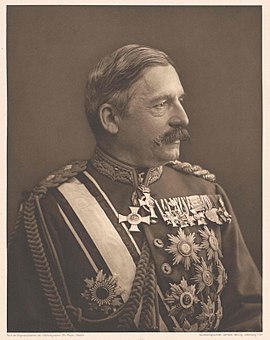
Max Clemens Lothar Freiherr von Hausen (December 17, 1846 – March 19, 1922) was a German army commander. He participated in the Austro-Prussian and Franco-German Wars and became Generaloberst of Saxon troops and War Minister in the Kingdom of Saxony. At the beginning of the First World War, he was the head of the Third Army which he led during the Battles of the Frontiers, Charleroi, and the Marne. He was relieved of his command because of illness in September 1914.
Contents
1 Early life
2 First World War
3 Dates of rank
4 Decorations and awards
5 Notes
6 References
7 External links
Early life
Coming from a military family Hausen entered the Saxon army as a cadet in the royal Saxon school of cadets. Being promoted to Seconde-Lieutenant in 1864 he joined the 3rd Jäger Battalion and served against Prussia in the Austro-Prussian War of 1866; where he saw action at the Battle of Königgrätz. After that war, Saxony allied with Prussia and became a part of the German Empire when it was created in 1871. From 1871 to 1874 Hausen taught at the Prussian military academy in Berlin and from 1875 until 1887 he served on the Imperial German General Staff. Being the chief of staff of the Saxon army from 1892 to 1895 he commanded the 32nd (3rd Royal Saxon) Division from 1897 to 1900 and the XII (1st Royal Saxon) Corps from 1900 to 1902. He served as Minister of War of the Kingdom of Saxony from 1902 to 1914, being promoted to Generaloberst in 1910.[1]
First World War
Upon mobilization in August 1914, the Royal Saxon Army became the German Third Army[2] and Hausen was given command. His army participated in the Battle of the Frontiers, mainly in the battles of Dinant, where Hausen's troops summarily executed over 600 of its inhabitants, including several women and children (one of them just 3 weeks old),[3] and Charleroi, and he and his army were responsible for the destruction of Reims in September 1914. When asked about how such deeds would eventually be known into history, he replied:
"We should write history ourselves."
After the Second Army's retreat after the First Battle of the Marne, Hausen saw his own flank exposed and ordered a retreat. After the stabilization of the front on the Aisne River, on September 9, 1914, Hausen was relieved of his command due to illness and replaced by General Karl von Einem. Hausen held no further field commands during the war, and died shortly after the war ended.
Dates of rank
- July 31, 1864: Sekonde-Lieutenant (2Lt)
- July 31, 1866: Premier-Lieutenant (1Lt)
- January 2, 1872: Hauptmann (Cpt)
- April 1, 1881: Major (Maj)
- April 1, 1887: Oberstleutnant (Ltc)
- March 20, 1890: Oberst (Col)
- March 25, 1893: Generalmajor (MGen)
- December 17, 1896: Generalleutnant (LGen)
- May 12, 1901: General der Infanterie (Gen)
- December 17, 1910: Generaloberst (ColGen)
Decorations and awards
 Kingdom of Saxony
- Order of the Rue Crown
- Knight's Cross of the Military Order of St. Henry
- Grand Cross of the Albert Order
 Kingdom of Prussia /
  German Empire

- Order of the Black Eagle
- Order of Merit of the Prussian Crown
- Grand Cross of the Order of the Red Eagle with chain
Iron Cross, 2nd Class of 1870
- Other German states
 Kingdom of Bavaria: Military Merit Order
 Grand Duchy of Baden: Order of the Zähringer Lion, Knight 1st Class
 Kingdom of Württemberg: Grand Cross of the Order of the Crown


 Austria-Hungary

- Grand Cross of the Order of Leopold
Notes
Regarding personal names: Freiherr is a former title (translated as Baron). In Germany since 1919, it forms part of family names. The feminine forms are Freifrau and Freiin.
^ Günter Wegner, Stellenbesetzung der deutschen Heere 1815-1939 (Biblio Verlag, Osnabrück, 1993)
^ 03. Armee - Der erste Weltkrieg Korps Stab Kriegschronik Oberbefehlshaber Flanke
^ Video on YouTube John Horne and Alan Kramer. The German Atrocities of 1914: A History of Denial, New Haven and London, Yale University Press, 2001. .mw-parser-output cite.citation{font-style:inherit}.mw-parser-output .citation q{quotes:"""""""'""'"}.mw-parser-output .citation .cs1-lock-free a{background:url("//upload.wikimedia.org/wikipedia/commons/thumb/6/65/Lock-green.svg/9px-Lock-green.svg.png")no-repeat;background-position:right .1em center}.mw-parser-output .citation .cs1-lock-limited a,.mw-parser-output .citation .cs1-lock-registration a{background:url("//upload.wikimedia.org/wikipedia/commons/thumb/d/d6/Lock-gray-alt-2.svg/9px-Lock-gray-alt-2.svg.png")no-repeat;background-position:right .1em center}.mw-parser-output .citation .cs1-lock-subscription a{background:url("//upload.wikimedia.org/wikipedia/commons/thumb/a/aa/Lock-red-alt-2.svg/9px-Lock-red-alt-2.svg.png")no-repeat;background-position:right .1em center}.mw-parser-output .cs1-subscription,.mw-parser-output .cs1-registration{color:#555}.mw-parser-output .cs1-subscription span,.mw-parser-output .cs1-registration span{border-bottom:1px dotted;cursor:help}.mw-parser-output .cs1-ws-icon a{background:url("//upload.wikimedia.org/wikipedia/commons/thumb/4/4c/Wikisource-logo.svg/12px-Wikisource-logo.svg.png")no-repeat;background-position:right .1em center}.mw-parser-output code.cs1-code{color:inherit;background:inherit;border:inherit;padding:inherit}.mw-parser-output .cs1-hidden-error{display:none;font-size:100%}.mw-parser-output .cs1-visible-error{font-size:100%}.mw-parser-output .cs1-maint{display:none;color:#33aa33;margin-left:0.3em}.mw-parser-output .cs1-subscription,.mw-parser-output .cs1-registration,.mw-parser-output .cs1-format{font-size:95%}.mw-parser-output .cs1-kern-left,.mw-parser-output .cs1-kern-wl-left{padding-left:0.2em}.mw-parser-output .cs1-kern-right,.mw-parser-output .cs1-kern-wl-right{padding-right:0.2em}
ISBN 0-300-08975-9. [A large summary http://webcache.googleusercontent.com/search?q=cache:7Z-4E_hgEkkJ:www.h-et.org/reviews/showpdf.cgi%3Fpath%3D48071096633975+Horne+Kramer+%2B+German+Atrocities&hl=fr&ct=clnk&cd=5&client=safari]
References
Barbara Tuchman, The Guns of August (New York, 1972)- Günter Wegner, Stellenbesetzung der deutschen Heere 1815-1939 (Biblio Verlag, Osnabrück, 1993)
External links
- FirstWorldWar.com Who's Who: Max von Hausen
| Military offices | ||
|---|---|---|
| Preceded by Heinrich Leo von Treitschke | Chief of General Staff of Saxony 9 March 1892 – 1 March 1895 | Succeeded by Hermann von Broizem |
| Preceded by Paul von der Planitz | Minister of War of Saxony 10 February 1902 – 21 May 1914 | Succeeded by Adolph von Carlowitz |
| Preceded by New Formation | Commander, 3rd Army 2 August – 12 September, 1914 | Succeeded by Karl von Einem |
Authority control  |
|
|---|


