Retarded potential
| Part of a series of articles about |
| Electromagnetism |
|---|
 |
|
Electrostatics
|
Magnetostatics
|
Electrodynamics
|
Electrical network
|
Covariant formulation
|
Scientists
|
In electrodynamics, the retarded potentials are the electromagnetic potentials for the electromagnetic field generated by time-varying electric current or charge distributions in the past. The fields propagate at the speed of light c, so the delay of the fields connecting cause and effect at earlier and later times is an important factor: the signal takes a finite time to propagate from a point in the charge or current distribution (the point of cause) to another point in space (where the effect is measured), see figure below.[1]
Contents
1 Potentials in the Lorenz gauge
1.1 Retarded and advanced potentials for time-dependent fields
1.2 Comparison with static potentials for time-independent fields
2 Potentials in the Coulomb gauge
3 Retarded potentials in linearized gravity
4 Occurrence and application
5 Example
6 See also
7 References
Potentials in the Lorenz gauge

Position vectors r and r′ used in the calculation.
The starting point is Maxwell's equations in the potential formulation using the Lorenz gauge:
- ◻φ=ρϵ0,◻A=μ0J{displaystyle Box varphi ={dfrac {rho }{epsilon _{0}}},,quad Box mathbf {A} =mu _{0}mathbf {J} }
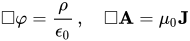
where φ(r, t) is the electric potential and A(r, t) is the magnetic potential, for an arbitrary source of charge density ρ(r, t) and current density J(r, t), and ◻{displaystyle Box }
Retarded and advanced potentials for time-dependent fields
For time-dependent fields, the retarded potentials are:[3][4]
- φ(r,t)=14πϵ0∫ρ(r′,tr)|r−r′|d3r′{displaystyle mathrm {varphi } (mathbf {r} ,t)={frac {1}{4pi epsilon _{0}}}int {frac {rho (mathbf {r} ',t_{r})}{|mathbf {r} -mathbf {r} '|}},mathrm {d} ^{3}mathbf {r} '}

- A(r,t)=μ04π∫J(r′,tr)|r−r′|d3r′.{displaystyle mathbf {A} (mathbf {r} ,t)={frac {mu _{0}}{4pi }}int {frac {mathbf {J} (mathbf {r} ',t_{r})}{|mathbf {r} -mathbf {r} '|}},mathrm {d} ^{3}mathbf {r} ',.}
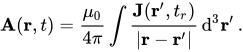
where r is a point in space, t is time,
- tr=t−|r−r′|c{displaystyle t_{r}=t-{frac {|mathbf {r} -mathbf {r} '|}{c}}}
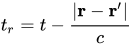
is the retarded time, and d3r' is the integration measure using r'.
From φ(r,t) and A(r, t), the fields E(r, t) and B(r, t) can be calculated using the definitions of the potentials:
- −E=∇φ+∂A∂t,B=∇×A.{displaystyle -mathbf {E} =nabla varphi +{frac {partial mathbf {A} }{partial t}},,quad mathbf {B} =nabla times mathbf {A} ,.}

and this leads to Jefimenko's equations. The corresponding advanced potentials have an identical form, except the advanced time
- ta=t+|r−r′|c{displaystyle t_{a}=t+{frac {|mathbf {r} -mathbf {r} '|}{c}}}
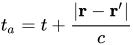
replaces the retarded time.
Comparison with static potentials for time-independent fields
In the case the fields are time-independent (electrostatic and magnetostatic fields), the time derivatives in the ◻{displaystyle Box }
- ∇2φ=−ρϵ0,∇2A=−μ0J,{displaystyle nabla ^{2}varphi =-{dfrac {rho }{epsilon _{0}}},,quad nabla ^{2}mathbf {A} =-mu _{0}mathbf {J} ,,}

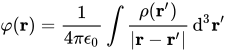
where ∇2 is the Laplacian, which take the form of Poisson's equation in four components (one for φ and three for A), and the solutions are:
- φ(r)=14πϵ0∫ρ(r′)|r−r′|d3r′{displaystyle mathrm {varphi } (mathbf {r} )={frac {1}{4pi epsilon _{0}}}int {frac {rho (mathbf {r} ')}{|mathbf {r} -mathbf {r} '|}},mathrm {d} ^{3}mathbf {r} '}
- A(r)=μ04π∫J(r′)|r−r′|d3r′.{displaystyle mathbf {A} (mathbf {r} )={frac {mu _{0}}{4pi }}int {frac {mathbf {J} (mathbf {r} ')}{|mathbf {r} -mathbf {r} '|}},mathrm {d} ^{3}mathbf {r} ',.}
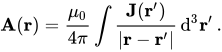
These also follow directly from the retarded potentials.
Potentials in the Coulomb gauge
In the Coulomb gauge, Maxwell's equations are[5]
- ∇2φ=−ρϵ0{displaystyle nabla ^{2}varphi =-{dfrac {rho }{epsilon _{0}}}}

- ∇2A−1c2∂2A∂t2=−μ0J+1c2∇(∂φ∂t),{displaystyle nabla ^{2}mathbf {A} -{dfrac {1}{c^{2}}}{dfrac {partial ^{2}mathbf {A} }{partial t^{2}}}=-mu _{0}mathbf {J} +{dfrac {1}{c^{2}}}nabla left({dfrac {partial varphi }{partial t}}right),,}

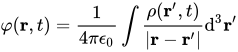
although the solutions contrast the above, since A is a retarded potential yet φ changes instantly, given by:
- φ(r,t)=14πϵ0∫ρ(r′,t)|r−r′|d3r′{displaystyle varphi (mathbf {r} ,t)={dfrac {1}{4pi epsilon _{0}}}int {dfrac {rho (mathbf {r} ',t)}{|mathbf {r} -mathbf {r} '|}}mathrm {d} ^{3}mathbf {r} '}
- A(r,t)=14πε0∇×∫d3r′∫0|r−r′|/cdtrtrJ(r′,t−tr)|r−r′|3×(r−r′).{displaystyle mathbf {A} (mathbf {r} ,t)={dfrac {1}{4pi varepsilon _{0}}}nabla times int mathrm {d} ^{3}mathbf {r'} int _{0}^{|mathbf {r} -mathbf {r} '|/c}mathrm {d} t_{r}{dfrac {t_{r}mathbf {J} (mathbf {r'} ,t-t_{r})}{|mathbf {r} -mathbf {r} '|^{3}}}times (mathbf {r} -mathbf {r} '),.}

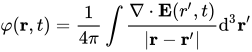
This presents an advantage and a disadvantage of the Coulomb gauge - φ is easily calculable from the charge distribution ρ but A is not so easily calculable from the current distribution j. However, provided we require that the potentials vanish at infinity, they can be expressed neatly in terms of fields:
- φ(r,t)=14π∫∇⋅E(r′,t)|r−r′|d3r′{displaystyle varphi (mathbf {r} ,t)={dfrac {1}{4pi }}int {dfrac {nabla cdot mathbf {E} ({r}',t)}{|mathbf {r} -mathbf {r} '|}}mathrm {d} ^{3}mathbf {r} '}
- A(r,t)=14π∫∇×B(r′,t)|r−r′|d3r′{displaystyle mathbf {A} (mathbf {r} ,t)={dfrac {1}{4pi }}int {dfrac {nabla times mathbf {B} ({r}',t)}{|mathbf {r} -mathbf {r} '|}}mathrm {d} ^{3}mathbf {r} '}

Retarded potentials in linearized gravity
The retarded potential in linearized general relativity is closely analogous to the electromagnetic case. The trace-reversed tensor h~μν=hμν−12ημνh{displaystyle {tilde {h}}_{mu nu }=h_{mu nu }-{frac {1}{2}}eta _{mu nu }h}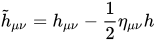


h~μν(r,t)=4G∫Tμν(r′,tr)|r−r′|d3r′{displaystyle {tilde {h}}_{mu nu }(mathbf {r} ,t)=4Gint {frac {T_{mu nu }(mathbf {r} ',t_{r})}{|mathbf {r} -mathbf {r} '|}}mathrm {d} ^{3}mathbf {r} '}.[6]
Occurrence and application
A many-body theory which includes an average of retarded and advanced Liénard–Wiechert potentials is the Wheeler–Feynman absorber theory also known as the Wheeler–Feynman time-symmetric theory.
Example
The potential of charge with uniform speed on a straight line has inversion in a point that is in the recent position. The potential is not changed in the direction of movement.[7]
See also
- Maxwell's Equations
- Liénard–Wiechert potential
- Lenz's law
References
^ McGraw Hill Encyclopaedia of Physics (2nd Edition), C.B. Parker, 1994, .mw-parser-output cite.citation{font-style:inherit}.mw-parser-output q{quotes:"""""""'""'"}.mw-parser-output code.cs1-code{color:inherit;background:inherit;border:inherit;padding:inherit}.mw-parser-output .cs1-lock-free a{background:url("//upload.wikimedia.org/wikipedia/commons/thumb/6/65/Lock-green.svg/9px-Lock-green.svg.png")no-repeat;background-position:right .1em center}.mw-parser-output .cs1-lock-limited a,.mw-parser-output .cs1-lock-registration a{background:url("//upload.wikimedia.org/wikipedia/commons/thumb/d/d6/Lock-gray-alt-2.svg/9px-Lock-gray-alt-2.svg.png")no-repeat;background-position:right .1em center}.mw-parser-output .cs1-lock-subscription a{background:url("//upload.wikimedia.org/wikipedia/commons/thumb/a/aa/Lock-red-alt-2.svg/9px-Lock-red-alt-2.svg.png")no-repeat;background-position:right .1em center}.mw-parser-output .cs1-subscription,.mw-parser-output .cs1-registration{color:#555}.mw-parser-output .cs1-subscription span,.mw-parser-output .cs1-registration span{border-bottom:1px dotted;cursor:help}.mw-parser-output .cs1-hidden-error{display:none;font-size:100%}.mw-parser-output .cs1-visible-error{font-size:100%}.mw-parser-output .cs1-subscription,.mw-parser-output .cs1-registration,.mw-parser-output .cs1-format{font-size:95%}.mw-parser-output .cs1-kern-left,.mw-parser-output .cs1-kern-wl-left{padding-left:0.2em}.mw-parser-output .cs1-kern-right,.mw-parser-output .cs1-kern-wl-right{padding-right:0.2em}
ISBN 0-07-051400-3
^ Garg, A., Classical Electromagnetism in a Nutshell, 2012, p. 129
^ Electromagnetism (2nd Edition), I.S. Grant, W.R. Phillips, Manchester Physics, John Wiley & Sons, 2008,
ISBN 978-0-471-92712-9
^ Introduction to Electrodynamics (3rd Edition), D.J. Griffiths, Pearson Education, Dorling Kindersley, 2007,
ISBN 81-7758-293-3
^ Introduction to Electrodynamics (3rd Edition), D.J. Griffiths, Pearson Education, Dorling Kindersley, 2007,
ISBN 81-7758-293-3
^ Sean M. Carroll, "Lecture Notes on General Relativity" (arXiv:gr-qc/9712019), equations 6.20, 6.21, 6.22, 6.74
^ http://www.feynmanlectures.caltech.edu/II_26.html - Feynman, Lecture 26, Lorentz Transformations of the Fields


