Insulin-like growth factor 2
| IGF2 | |||||||||||||||||||||||||
|---|---|---|---|---|---|---|---|---|---|---|---|---|---|---|---|---|---|---|---|---|---|---|---|---|---|
 | |||||||||||||||||||||||||
| Identifiers | |||||||||||||||||||||||||
| Aliases | IGF2, C11orf43, GRDF, IGF-II, PP9974, insulin like growth factor 2 | ||||||||||||||||||||||||
| External IDs | OMIM: 147470 MGI: 96434 HomoloGene: 510 GeneCards: IGF2 | ||||||||||||||||||||||||
| |||||||||||||||||||||||||
| |||||||||||||||||||||||||
| |||||||||||||||||||||||||
| Orthologs | |||||||||||||||||||||||||
| Species | Human | Mouse | |||||||||||||||||||||||
| Entrez |
|
| |||||||||||||||||||||||
| Ensembl |
|
| |||||||||||||||||||||||
| UniProt |
|
| |||||||||||||||||||||||
| RefSeq (mRNA) |
|
| |||||||||||||||||||||||
| RefSeq (protein) |
|
| |||||||||||||||||||||||
| Location (UCSC) | n/a | Chr 7: 142.65 – 142.67 Mb | |||||||||||||||||||||||
PubMed search | [2] | [3] | |||||||||||||||||||||||
| Wikidata | |||||||||||||||||||||||||
| |||||||||||||||||||||||||



| Insulin-like growth factor II E-peptide (somatomedians-A ) | |||||||||
|---|---|---|---|---|---|---|---|---|---|
| Identifiers | |||||||||
| Symbol | IGF2_C | ||||||||
| Pfam | PF08365 | ||||||||
| InterPro | IPR013576 | ||||||||
| |||||||||
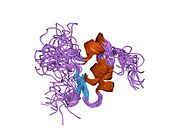
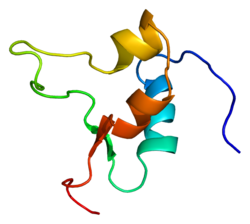
Insulin-like growth factor 2 (IGF-2) is one of three protein hormones that share structural similarity to insulin. The MeSH definition reads: "A well-characterized neutral peptide believed to be secreted by the liver and to circulate in the blood. It has growth-regulating, insulin-like and mitogenic activities. The growth factor has a major, but not absolute, dependence on somatotropin. It is believed to be a major fetal growth factor in contrast to Insulin-like growth factor 1, which is a major growth factor in adults".[4]
Contents
1 Gene structure
2 Function
3 Clinical relevance
4 Interactions
5 See also
6 References
7 Further reading
8 External links
Gene structure
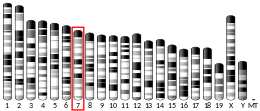
In humans, the IGF2 gene is located on chromosome 11p15.5, a region which contains numerous imprinted genes. In mice this homologous region is found at distal chromosome 7. In both organisms, Igf2 is imprinted, with expression resulting favourably from the paternally inherited allele. However, in some human brain regions a loss of imprinting occurs resulting in both IGF2 and H19 being transcribed from both parental alleles.[5]
The protein CTCF is involved in repressing expression of the gene, by binding to the H19 imprinting control region (ICR) along with Differentially-methylated Region-1 (DMR1) and Matrix Attachment Region −3 (MAR3). These three DNA sequences bind to CTCF in a way that limits downstream enhancer access to the Igf2 region. The mechanism in which CTCF binds to these regions is currently unknown, but could include either a direct DNA-CTCF interaction or it could possibly be mediated by other proteins.
In mammals (mice, humans, pigs), only the allele for insulin-like growth factor-2 (IGF2) inherited from one's father is active; that inherited from the mother is not — a phenomenon called imprinting. The mechanism: the mother's allele has an insulator between the IGF2 promoter and enhancer. So does the father's allele, but in his case, the insulator has been methylated. CTCF can no longer bind to the insulator, and so the enhancer is now free to turn on the father's IGF2 promoter.[6]
Function
The major role of IGF-2 is as a growth promoting hormone during gestation.
IGF-2 exerts its effects by binding to the IGF-1 receptor and to the short isoform of the insulin receptor (IR-A or exon 11-).[7] IGF2 may also bind to the IGF-2 receptor (also called the cation-independent mannose 6-phosphate receptor), which acts as a signalling antagonist; that is, to prevent IGF2 responses.
In the process of folliculogenesis, IGF-2 is created by thecal cells to act in an autocrine manner on the theca cells themselves, and in a paracrine manner on granulosa cells in the ovary.[citation needed] IGF2 promotes granulosa cell proliferation during the follicular phase of the menstrual cycle, acting alongside follicle stimulating hormone (FSH).[8] After ovulation has occurred, IGF-2 promotes progesterone secretion during the luteal phase of the menstrual cycle, together with luteinizing hormone (LH). Thus, IGF2 acts as a co-hormone together with both FSH and LH.[9]
A study at the Mount Sinai School of Medicine found that IGF-2 may be linked to memory and reproduction.[10] A study at the European Neuroscience Institute-Goettingen (Germany) found that fear extinction-induced IGF2/IGFBP7 signalling promotes the survival of 17- to 19-day-old newborn hippocampal neurons. This suggests that therapeutic strategies that enhance IGF2 signalling and adult neurogenesis might be suitable to treat diseases linked to excessive fear memory such as PTSD.[11]
Clinical relevance
It is sometimes produced in excess in islet cell tumors and non-islet hypoglycemic cell tumors, causing hypoglycemia. Doege-Potter syndrome is a paraneoplastic syndrome[12] in which hypoglycemia is associated with the presence of one or more non-islet fibrous tumors in the pleural cavity. Loss of imprinting of IGF2 is a common feature in tumors seen in Beckwith-Wiedemann syndrome. As IGF2 promotes development of fetal pancreatic beta cells, it is believed to be related to some forms of diabetes mellitus. Preeclampsia induces a decrease in methylation level at IGF2 demethylated region, and this might be among the mechanisms behind the association between intrauterine exposure to preeclampsia and high risk for metabolic diseases in the later life of the infants.[13]
Interactions
Insulin-like growth factor 2 has been shown to interact with IGFBP3[14][15][16][17] and transferrin.[14]
See also
- Insulin-like growth factor 2 receptor
- Insulin-like growth factor II IRES
References
^ abc GRCm38: Ensembl release 89: ENSMUSG00000048583 - Ensembl, May 2017
^ "Human PubMed Reference:"..mw-parser-output cite.citation{font-style:inherit}.mw-parser-output q{quotes:"""""""'""'"}.mw-parser-output code.cs1-code{color:inherit;background:inherit;border:inherit;padding:inherit}.mw-parser-output .cs1-lock-free a{background:url("//upload.wikimedia.org/wikipedia/commons/thumb/6/65/Lock-green.svg/9px-Lock-green.svg.png")no-repeat;background-position:right .1em center}.mw-parser-output .cs1-lock-limited a,.mw-parser-output .cs1-lock-registration a{background:url("//upload.wikimedia.org/wikipedia/commons/thumb/d/d6/Lock-gray-alt-2.svg/9px-Lock-gray-alt-2.svg.png")no-repeat;background-position:right .1em center}.mw-parser-output .cs1-lock-subscription a{background:url("//upload.wikimedia.org/wikipedia/commons/thumb/a/aa/Lock-red-alt-2.svg/9px-Lock-red-alt-2.svg.png")no-repeat;background-position:right .1em center}.mw-parser-output .cs1-subscription,.mw-parser-output .cs1-registration{color:#555}.mw-parser-output .cs1-subscription span,.mw-parser-output .cs1-registration span{border-bottom:1px dotted;cursor:help}.mw-parser-output .cs1-hidden-error{display:none;font-size:100%}.mw-parser-output .cs1-visible-error{font-size:100%}.mw-parser-output .cs1-subscription,.mw-parser-output .cs1-registration,.mw-parser-output .cs1-format{font-size:95%}.mw-parser-output .cs1-kern-left,.mw-parser-output .cs1-kern-wl-left{padding-left:0.2em}.mw-parser-output .cs1-kern-right,.mw-parser-output .cs1-kern-wl-right{padding-right:0.2em}
^ "Mouse PubMed Reference:".
^ "Insulin-Like Growth Factor II". MeSH. NCBI.
^ Pham NV, Nguyen MT, Hu JF, Vu TH, Hoffman AR (Nov 1998). "Dissociation of IGF2 and H19 imprinting in human brain". Brain Research. 810 (1–2): 1–8. doi:10.1016/s0006-8993(98)00783-5. PMID 9813220.
^ Russell PJ (2009). iGenetics: A Molecular Approach (3rd ed.). Upper Saddle River, N.J.: Pearson Education. p. 533. ISBN 978-0-321-61022-5.
^ Frasca F, Pandini G, Scalia P, Sciacca L, Mineo R, Costantino A, Goldfine ID, Belfiore A, Vigneri R (1999). "Insulin receptor isoform A, a newly recognized, high-affinity insulin-like growth factor II receptor in fetal and cancer cells". Molecular and Cellular Biology. 19 (5): 3278–88. doi:10.1128/MCB.19.5.3278. PMC 84122. PMID 10207053.
^ Neidhart, M (2016). DNA Methylation and Complex Human Disease (1st ed.). San Diego: Academic Press. p. 222.
ISBN 9780124201941.
^ Neidhart, M (2016). DNA Methylation and Complex Human Disease (1st ed.). San Diego: Academic Press. p. 22.
ISBN 978-0124201941.
^ Chen DY, Stern SA, Garcia-Osta A, Saunier-Rebori B, Pollonini G, Bambah-Mukku D, Blitzer RD, Alberini CM (Jan 2011). "A critical role for IGF-II in memory consolidation and enhancement". Nature. 469 (7331): 491–7. doi:10.1038/nature09667. PMC 3908455. PMID 21270887.
^ Agis-Balboa RC, Arcos-Diaz D, Wittnam J, Govindarajan N, Blom K, Burkhardt S, Haladyniak U, Agbemenyah HY, Zovoilis A, Salinas-Riester G, Opitz L, Sananbenesi F, Fischer A (Oct 2011). "A hippocampal insulin-growth factor 2 pathway regulates the extinction of fear memories". The EMBO Journal. 30 (19): 4071–83. doi:10.1038/emboj.2011.293. PMC 3209781. PMID 21873981.
^ Balduyck B, Lauwers P, Govaert K, Hendriks J, De Maeseneer M, Van Schil P (Jul 2006). "Solitary fibrous tumor of the pleura with associated hypoglycemia: Doege-Potter syndrome: a case report". Journal of Thoracic Oncology. 1 (6): 588–90. doi:10.1097/01243894-200607000-00016. PMID 17409923.
^ He J, Zhang A, Fang M, Fang R, Ge J, Jiang Y, Zhang H, Han C, Ye X, Yu D, Huang H, Liu Y, Dong M (12 July 2013). "Methylation levels at IGF2 and GNAS DMRs in infants born to preeclamptic pregnancies". BMC Genomics. 14: 472. doi:10.1186/1471-2164-14-472. PMC 3723441. PMID 23844573.
^ ab Storch S, Kübler B, Höning S, Ackmann M, Zapf J, Blum W, Braulke T (Dec 2001). "Transferrin binds insulin-like growth factors and affects binding properties of insulin-like growth factor binding protein-3". FEBS Letters. 509 (3): 395–8. doi:10.1016/S0014-5793(01)03204-5. PMID 11749962.
^ Buckway CK, Wilson EM, Ahlsén M, Bang P, Oh Y, Rosenfeld RG (Oct 2001). "Mutation of three critical amino acids of the N-terminal domain of IGF-binding protein-3 essential for high affinity IGF binding". The Journal of Clinical Endocrinology and Metabolism. 86 (10): 4943–50. doi:10.1210/jcem.86.10.7936. PMID 11600567.
^ Twigg SM, Baxter RC (Mar 1998). "Insulin-like growth factor (IGF)-binding protein 5 forms an alternative ternary complex with IGFs and the acid-labile subunit". The Journal of Biological Chemistry. 273 (11): 6074–9. doi:10.1074/jbc.273.11.6074. PMID 9497324.
^ Firth SM, Ganeshprasad U, Baxter RC (Jan 1998). "Structural determinants of ligand and cell surface binding of insulin-like growth factor-binding protein-3". The Journal of Biological Chemistry. 273 (5): 2631–8. doi:10.1074/jbc.273.5.2631. PMID 9446566.
Further reading
.mw-parser-output .refbegin{font-size:90%;margin-bottom:0.5em}.mw-parser-output .refbegin-hanging-indents>ul{list-style-type:none;margin-left:0}.mw-parser-output .refbegin-hanging-indents>ul>li,.mw-parser-output .refbegin-hanging-indents>dl>dd{margin-left:0;padding-left:3.2em;text-indent:-3.2em;list-style:none}.mw-parser-output .refbegin-100{font-size:100%}
O'Dell SD, Day IN (Jul 1998). "Insulin-like growth factor II (IGF-II)". The International Journal of Biochemistry & Cell Biology. 30 (7): 767–71. doi:10.1016/S1357-2725(98)00048-X. PMID 9722981.
Butler AA, Yakar S, Gewolb IH, Karas M, Okubo Y, LeRoith D (Sep 1998). "Insulin-like growth factor-I receptor signal transduction: at the interface between physiology and cell biology". Comparative Biochemistry and Physiology B. 121 (1): 19–26. doi:10.1016/S0305-0491(98)10106-2. PMID 9972281.
Kalli KR, Conover CA (May 2003). "The insulin-like growth factor/insulin system in epithelial ovarian cancer". Frontiers in Bioscience. 8: d714–22. doi:10.2741/1034. PMID 12700030.
Wood AW, Duan C, Bern HA (2005). "Insulin-like growth factor signaling in fish". International Review of Cytology. 243: 215–85. doi:10.1016/S0074-7696(05)43004-1. PMID 15797461.
Fowden AL, Sibley C, Reik W, Constancia M (2006). "Imprinted genes, placental development and fetal growth". Hormone Research. 65 Suppl 3 (3): 50–8. doi:10.1159/000091506. PMID 16612114.
External links
Insulin-Like+Growth+Factor+II at the US National Library of Medicine Medical Subject Headings (MeSH)
PDB gallery | |
|---|---|
|