Madagascar sucker-footed bat
| Madagascar sucker-footed bat Temporal range: Pleistocene to Recent | |
|---|---|
Conservation status | |
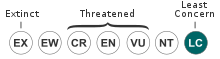 Least Concern (IUCN 3.1)[1] | |
Scientific classification | |
| Kingdom: | Animalia |
| Phylum: | Chordata |
| Class: | Mammalia |
| Order: | Chiroptera |
| Family: | Myzopodidae |
| Genus: | Myzopoda |
| Species: | M. aurita |
Binomial name | |
Myzopoda aurita Milne-Edwards & A. Grandidier, 1878 | |
 | |
| Madagascar sucker-footed bat range | |
The Madagascar sucker-footed bat, Old World sucker-footed bat, or simply sucker-footed bat (Myzopoda aurita) is a species of bat in the family Myzopodidae endemic to Madagascar, especially in the eastern part of the forests.[2] The genus was thought to be monospecific until a second species, Myzopoda schliemanni, was discovered in the central western lowlands.[3] It was classified as Vulnerable in the 1996 IUCN Red List of Threatened Species but is now known to be more abundant and was reclassified in 2008 as of "Least Concern".[1]
The bat is named for the presence of small cups on its wrists and ankles. They roost inside the rolled leaves of the traveller's tree,[4] using their suckers to attach themselves to the smooth surface.[5] Despite the name, it is now known that the bats do not use suction to attach themselves to roost sites, but instead use a form of wet adhesion by secreting a body fluid at their pads.[6]
Because of their unique habitat, sucker-footed bats don't carry ectoparasites, due to the smooth surface of the Ravenala leaves being inhospitable to small arthropods[4] The majority of sucker-footed bats caught in eastern Madagascar were within or close to stands of traveller's trees,[4] and according to research, the maximum distance they will travel while foraging is about 1.8 km (1.1 mi).[4] Sucker-footed bats feed largely on beetles and small moths.[4][7]
References
^ ab Monadjem, A.; Cardiff, S.G.; Rakotoarivelo, A.R.; Jenkins, R.K.B.; Ratrimomanarivo, F.H. (2017). "Myzopoda aurita". The IUCN Red List of Threatened Species. 2017: e.T14288A22073303..mw-parser-output cite.citation{font-style:inherit}.mw-parser-output q{quotes:"""""""'""'"}.mw-parser-output code.cs1-code{color:inherit;background:inherit;border:inherit;padding:inherit}.mw-parser-output .cs1-lock-free a{background:url("//upload.wikimedia.org/wikipedia/commons/thumb/6/65/Lock-green.svg/9px-Lock-green.svg.png")no-repeat;background-position:right .1em center}.mw-parser-output .cs1-lock-limited a,.mw-parser-output .cs1-lock-registration a{background:url("//upload.wikimedia.org/wikipedia/commons/thumb/d/d6/Lock-gray-alt-2.svg/9px-Lock-gray-alt-2.svg.png")no-repeat;background-position:right .1em center}.mw-parser-output .cs1-lock-subscription a{background:url("//upload.wikimedia.org/wikipedia/commons/thumb/a/aa/Lock-red-alt-2.svg/9px-Lock-red-alt-2.svg.png")no-repeat;background-position:right .1em center}.mw-parser-output .cs1-subscription,.mw-parser-output .cs1-registration{color:#555}.mw-parser-output .cs1-subscription span,.mw-parser-output .cs1-registration span{border-bottom:1px dotted;cursor:help}.mw-parser-output .cs1-hidden-error{display:none;font-size:100%}.mw-parser-output .cs1-visible-error{font-size:100%}.mw-parser-output .cs1-subscription,.mw-parser-output .cs1-registration,.mw-parser-output .cs1-format{font-size:95%}.mw-parser-output .cs1-kern-left,.mw-parser-output .cs1-kern-wl-left{padding-left:0.2em}.mw-parser-output .cs1-kern-right,.mw-parser-output .cs1-kern-wl-right{padding-right:0.2em}
^ H., Schliemann; Goodman, S.M. (2003). "Myzopoda aurita, Old World sucker-footed bat". The natural history of Madagascar: 1303–1306.
^ Goodman, S.M.; Rakotondraparany, F.; Kofoky, A. (2006). "The description of a new species of Myzopoda (Myzopodidae: Chiroptera) from western Madagascar". Mammalian Biology. 72: 65–81. doi:10.1016/j.mambio.2006.08.001.
^ abcde M., Ralisata; F. R. Andriamboavonjy; D. Rakotondravony; O. R. Ravoahangimalala; F. H. Randrianandrianina; P. A. Racey (2010). "Monastic Myzopoda: the foraging and roosting ecology of a sexually segregated Malagasy endemic bat". Journal of Zoology. 282 (2): 130–139. doi:10.1111/j.1469-7998.2010.00724.x.
^ Macdonald, D., ed. (1984). The Encyclopedia of Mammals. New York: Facts on File. p. 807. ISBN 0-87196-871-1.
^ Brown University News, December 2009, Bats Don’t Use Suction After All
^ Göpfert, M.C.; Wasserthal, L.T. (1995). "Notes on echolocation calls, food and roosting behavior of the Old World sucker-footed bat Myzopoda aurita (Chiroptera, Myzopodidae)". Zeitschrift für Säugetierkunde. 60: 1–8.
External links
"Monastic" Malagasy bat mystifies experts BBC Earth News 13 July 2010


