Non-metropolitan district
| Non-metropolitan district | |
|---|---|
Also known as: Shire district | |
 | |
| Category | Local authority districts |
| Location | England |
| Found in | Non-metropolitan county |
| Created by | Local Government Act 1972 |
| Created | 1 April 1974 |
| Number | 256 (as of 2009) |
| Possible types | Two-tier (201) Unitary authority (55) |
| Possible status | City Royal borough Borough |
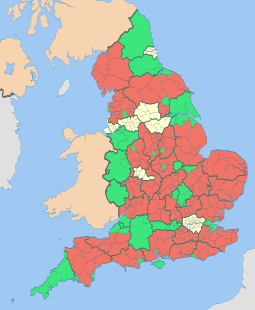
Non-metropolitan districts, or colloquially "shire districts", are a type of local government district in England. As created, they are sub-divisions of non-metropolitan counties (colloquially shire counties) in a two-tier arrangement.
Contents
1 Non-metropolitan districts
2 Status
3 History
3.1 Scotland and Wales
4 District Councils' Network
5 List of counties and districts
6 List of abolished non-metropolitan districts
7 See also
8 References
9 External links
Non-metropolitan districts
Non-metropolitan districts are subdivisions of English non-metropolitan counties which have a two-tier structure of local government.[1] Most non-metropolitan counties have a county council, and also have several districts, each with a borough or district council. In these cases local government functions are divided between county and district councils, to the level where they can be practised most efficiently:
- Borough/district councils are responsible for local planning and building control, local roads, council housing, environmental health, markets and fairs, refuse collection and recycling, cemeteries and crematoria, leisure services, parks, and tourism.
- County councils are responsible for running the largest and most expensive local services such as education, social services, libraries, main roads, public transport, policing and fire services, Trading Standards, waste disposal and strategic planning.
| Service | Non-metropolitan county | Non-metropolitan district | Unitary authority |
|---|---|---|---|
| Education |  Y Y | Y | |
| Housing | Y | Y | |
| Planning applications | Y | Y | |
| Strategic planning | Y | Y | |
| Transport planning | Y | Y | |
| Passenger transport | Y | Y | |
| Highways | Y | Y | |
| Fire | Y | Y | |
| Social services | Y | Y | |
| Libraries | Y | Y | |
| Leisure and recreation | Y | Y | |
| Waste collection | Y | Y | |
| Waste disposal | Y | Y | |
| Environmental health | Y | Y | |
| Revenue collection | Y | Y |
Status
Many districts have borough status, which means the local council is called a borough council instead of district council and gives them the right to appoint a mayor. Borough status is granted by royal charter and, in many cases, continues a style enjoyed by a predecessor authority, which can date back centuries. Some districts such as Oxford or Exeter have city status, granted by letters patent, but this does not give the local council any extra powers other than the right to call itself a city council. Not all city or borough councils are non-metropolitan districts, many being unitary authorities – districts which are ceremonially part of a non-metropolitan county, but not run by the county council – or metropolitan districts – which were subdivisions of the metropolitan counties created in 1974, but whose county councils were abolished in the 1980s and are effectively unitary authorities and have the same powers.
History
By 1899, England had been divided at district level into rural districts, urban districts, municipal boroughs, county boroughs and metropolitan boroughs. This system was abolished by the London Government Act 1963 and the Local Government Act 1972. Non-metropolitan districts were created by this act in 1974 when England outside Greater London was divided into metropolitan counties and non-metropolitan counties. Metropolitan counties were sub-divided into metropolitan districts and the non-metropolitan counties were sub-divided into non-metropolitan districts. The metropolitan districts had more powers than their non-metropolitan counterparts. Initially, there were 296 non-metropolitan districts in the two-tier structure, but reforms in the 1990s and 2009 reduced their number to 201. A further 55 non-metropolitan districts are now unitary authorities, which combine the functions of county and borough/district councils.
Scotland and Wales
In Wales, an almost identical two-tier system of local government existed between 1974 and 1996 (see Districts of Wales). In 1996, this was abolished and replaced with an entirely unitary system of local government, with one level of local government responsible for all local services. Since the areas for Wales and England had been enacted separately and there were no Welsh metropolitan areas, the term 'non-metropolitan district' does not apply to Wales. A similar system existed in Scotland, which in 1975 was divided into regions and districts, this was also abolished in 1996 and replaced with a fully unitary system.
District Councils' Network
In England 200 out of the 201 non-metropolitan district councils are represented by the District Councils' Network,[2] special interest group which sits within the Local Government Association.[3] The network's purpose is to "act as an informed and representative advocate for districts to government and other national bodies, based on their unique position to deliver for ‘local’ people.”
List of counties and districts
This is a list of non-metropolitan counties and their districts. Some non-metropolitan districts are coterminous with non-metropolitan counties, making them unitary authorities (for example Herefordshire, the Isle of Wight, and Rutland). These are excluded from this list as is Berkshire which has no county council.
For a full list of districts of all types including unitary authorities, metropolitan districts and London boroughs, see Districts of England.
| Non-metropolitan county | Non-metropolitan districts (excluding unitary authorities) | Number |
|---|---|---|
| Buckinghamshire | South Bucks – Chiltern – Wycombe – Aylesbury Vale | 4 |
| Cambridgeshire | Cambridge – South Cambridgeshire – Huntingdonshire – Fenland – East Cambridgeshire | 5 |
| Cumbria | Barrow-in-Furness – South Lakeland – Copeland – Allerdale – Eden – Carlisle | 6 |
| Derbyshire | High Peak – Derbyshire Dales – South Derbyshire – Erewash – Amber Valley – North East Derbyshire – Chesterfield – Bolsover | 8 |
| Devon | Exeter – East Devon – Mid Devon – North Devon – Torridge – West Devon – South Hams – Teignbridge | 8 |
| Dorset | Weymouth and Portland – West Dorset – North Dorset – Purbeck – East Dorset – Christchurch | 6 |
| East Sussex | Hastings – Rother – Wealden – Eastbourne – Lewes | 5 |
| Essex | Harlow – Epping Forest – Brentwood – Basildon – Castle Point – Rochford – Maldon – Chelmsford – Uttlesford – Braintree – Colchester – Tendring | 12 |
| Gloucestershire | Gloucester – Tewkesbury – Cheltenham – Cotswold – Stroud – Forest of Dean | 6 |
| Hampshire | Gosport – Fareham – Winchester – Havant – East Hampshire – Hart – Rushmoor – Basingstoke and Deane – Test Valley – Eastleigh – New Forest | 11 |
| Hertfordshire | Three Rivers – Watford – Hertsmere – Welwyn Hatfield – Broxbourne – East Hertfordshire – Stevenage – North Hertfordshire – St Albans – Dacorum | 10 |
| Kent | Dartford – Gravesham – Sevenoaks – Tonbridge and Malling – Tunbridge Wells – Maidstone – Swale – Ashford – Folkestone and Hythe – Canterbury – Dover – Thanet | 12 |
| Lancashire | West Lancashire – Chorley – South Ribble – Fylde – Preston – Wyre – Lancaster – Ribble Valley – Pendle – Burnley – Rossendale – Hyndburn | 12 |
| Leicestershire | Charnwood – Melton – Harborough – Oadby and Wigston – Blaby – Hinckley and Bosworth – North West Leicestershire | 7 |
| Lincolnshire | Lincoln – North Kesteven – South Kesteven – South Holland – Boston – East Lindsey – West Lindsey | 7 |
| Norfolk | Norwich – South Norfolk – Great Yarmouth – Broadland – North Norfolk – King's Lynn and West Norfolk – Breckland | 7 |
| Northamptonshire | South Northamptonshire – Northampton – Daventry – Wellingborough – Kettering – Corby – East Northamptonshire | 7 |
| North Yorkshire | Selby – Harrogate – Craven – Richmondshire – Hambleton – Ryedale – Scarborough | 7 |
| Nottinghamshire | Rushcliffe – Broxtowe – Ashfield – Gedling – Newark and Sherwood – Mansfield – Bassetlaw | 7 |
| Oxfordshire | Oxford – Cherwell – South Oxfordshire – Vale of White Horse – West Oxfordshire | 5 |
| Somerset | South Somerset – Taunton Deane – West Somerset – Sedgemoor – Mendip | 5 |
| Staffordshire | Tamworth – Lichfield – Cannock Chase – South Staffordshire – Stafford – Newcastle-under-Lyme – Staffordshire Moorlands – East Staffordshire | 8 |
| Suffolk | Ipswich – Suffolk Coastal – Waveney – Mid Suffolk – Babergh – St Edmundsbury – Forest Heath | 7 |
| Surrey | Spelthorne – Runnymede – Surrey Heath – Woking – Elmbridge – Guildford – Waverley – Mole Valley – Epsom and Ewell – Reigate and Banstead – Tandridge | 11 |
| Warwickshire | North Warwickshire – Nuneaton and Bedworth – Rugby – Stratford-on-Avon – Warwick | 5 |
| West Sussex | Worthing – Arun – Chichester – Horsham – Crawley – Mid Sussex – Adur | 7 |
| Worcestershire | Worcester – Malvern Hills – Wyre Forest – Bromsgrove – Redditch – Wychavon | 6 |
| Total | 201 | |
List of abolished non-metropolitan districts
This is a list of former two-tier districts in England which have been abolished, by local government reorganisations such as the 2009 structural changes to local government in England. It does not include districts that still exist after becoming a unitary authority or those that transferred from one county to another, including those that changed name.
| Non-metropolitan county (at time of abolition) | Abolished non-metropolitan districts | Number |
|---|---|---|
| Avon | Bath – Kingswood – Northavon – Wansdyke | 4 |
| Bedfordshire | Mid Bedfordshire – South Bedfordshire | 2 |
| Cheshire | Chester – Congleton – Crewe and Nantwich – Ellesmere Port and Neston – Macclesfield – Vale Royal | 6 |
| Cornwall | Caradon – Carrick – Kerrier – North Cornwall – Penwith – Restormel | 6 |
| Durham | Durham – Easington – Sedgefield – Chester-le-Street – Derwentside – Wear Valley – Teesdale | 7 |
| East Sussex | Brighton – Hove | 2 |
| Hereford and Worcester | Hereford – Leominster – South Herefordshire | 3 |
| Humberside | Beverley – Boothferry – Cleethorpes – East Yorkshire – Glanford – Great Grimsby – Holderness – Scunthorpe | 8 |
| Isle of Wight | Medina – South Wight | 2 |
| Kent | Gillingham – Rochester-upon-Medway | 2 |
| Northumberland | Blyth Valley – Wansbeck – Castle Morpeth – Tynedale – Alnwick – Berwick-upon-Tweed | 6 |
| Shropshire | Bridgnorth – North Shropshire – Oswestry – Shrewsbury and Atcham – South Shropshire | 5 |
| Wiltshire | Kennet – North Wiltshire – Salisbury – West Wiltshire | 4 |
| Total | 57 | |
See also

- List of articles about local government in the United Kingdom
- District Councils' Network
References
^ National Statistics – Counties, Non-metropolitan Districts and Unitary Authorities Archived 9 May 2002 at the UK Government Web Archive
^ "Members | District Councils' Network". Districtcouncils.info. Retrieved 24 September 2013..mw-parser-output cite.citation{font-style:inherit}.mw-parser-output q{quotes:"""""""'""'"}.mw-parser-output code.cs1-code{color:inherit;background:inherit;border:inherit;padding:inherit}.mw-parser-output .cs1-lock-free a{background:url("//upload.wikimedia.org/wikipedia/commons/thumb/6/65/Lock-green.svg/9px-Lock-green.svg.png")no-repeat;background-position:right .1em center}.mw-parser-output .cs1-lock-limited a,.mw-parser-output .cs1-lock-registration a{background:url("//upload.wikimedia.org/wikipedia/commons/thumb/d/d6/Lock-gray-alt-2.svg/9px-Lock-gray-alt-2.svg.png")no-repeat;background-position:right .1em center}.mw-parser-output .cs1-lock-subscription a{background:url("//upload.wikimedia.org/wikipedia/commons/thumb/a/aa/Lock-red-alt-2.svg/9px-Lock-red-alt-2.svg.png")no-repeat;background-position:right .1em center}.mw-parser-output .cs1-subscription,.mw-parser-output .cs1-registration{color:#555}.mw-parser-output .cs1-subscription span,.mw-parser-output .cs1-registration span{border-bottom:1px dotted;cursor:help}.mw-parser-output .cs1-hidden-error{display:none;font-size:100%}.mw-parser-output .cs1-visible-error{font-size:100%}.mw-parser-output .cs1-subscription,.mw-parser-output .cs1-registration,.mw-parser-output .cs1-format{font-size:95%}.mw-parser-output .cs1-kern-left,.mw-parser-output .cs1-kern-wl-left{padding-left:0.2em}.mw-parser-output .cs1-kern-right,.mw-parser-output .cs1-kern-wl-right{padding-right:0.2em}
^ "Special interest groups | Local Government Association". Government of the United Kingdom. 30 August 2013. Retrieved 24 September 2013.
External links
- Map of the UK counties and unitary administrations
- Map of all UK local authorities
 Subdivisions of England Subdivisions of England | |
|---|---|
| Region |
|
| Ceremonial County |
|
| Administrative County |
|
| District |
|
| Unitary Authority |
|
| Sui-Generis |
|
| Civil Parish |
|


