Ordinal utility
In economics, an ordinal utility function is a function representing the preferences of an agent on an ordinal scale. The ordinal utility theory claims that it is only meaningful to ask which option is better than the other, but it is meaningless to ask how much better it is or how good it is. All of the theory of consumer decision-making under conditions of certainty can be, and typically is, expressed in terms of ordinal utility.
For example, suppose George tells us that "I prefer A to B and B to C". George's preferences can be represented by a function u such that:
- u(A)=9,u(B)=8,u(C)=1{displaystyle u(A)=9,u(B)=8,u(C)=1}

But the only meaningful message of this function is the order u(A)>u(B)>u(C){displaystyle u(A)>u(B)>u(C)}
- v(A)=9,v(B)=2,v(C)=1{displaystyle v(A)=9,v(B)=2,v(C)=1}

The functions u and v are ordinally equivalent – they represent George's preferences equally well.
Ordinal utility contrasts with cardinal utility theory: the latter assumes that the differences between preferences are also important. In u the difference between A and B is much smaller than between B and C, while in v the opposite is true. Hence, u and v are not cardinally equivalent.
The ordinal utility concept was first introduced by Pareto in 1906.[1]
Contents
1 Notation
2 Related concepts
2.1 Indifference curve mappings
2.2 Revealed preference
3 Necessary conditions for existence of ordinal utility function
4 Continuity
5 Uniqueness
6 Monotonicity
7 Marginal rate of substitution
8 Linearity
9 Quasilinearity
10 Additivity with two goods
10.1 Double cancellation property
10.2 Corresponding tradeoffs property
11 Additivity with three or more goods
11.1 Uniqueness of additive representation
12 Comparison between ordinal and cardinal utility functions
13 See also
14 References
15 External links
Notation
Suppose the set of all states of the world is X{displaystyle X}


The symbol ∼{displaystyle sim }

The symbol ≺{displaystyle prec }

A function u:X→R{displaystyle u:Xto mathbb {R} }
- A⪯B⟺u(A)≤u(B){displaystyle Apreceq Biff u(A)leq u(B)}

Related concepts
Indifference curve mappings
Instead of defining a numeric function, an agent's preference relation can be represented graphically by indifference curves. This is especially useful when there are two kinds of goods, x and y. Then, each indifference curve shows a set of points (x,y){displaystyle (x,y)}



An example indifference curve is shown below:

Each indifference curve is a set of points, each representing a combination of quantities of two goods or services, all of which combinations the consumer is equally satisfied with. The further a curve is from the origin, the greater is the level of utility.
The slope of the curve (the negative of the marginal rate of substitution of X for Y) at any point shows the rate at which the individual is willing to trade off good X against good Y maintaining the same level of utility. The curve is convex to the origin as shown assuming the consumer has a diminishing marginal rate of substitution. It can be shown that consumer analysis with indifference curves (an ordinal approach) gives the same results as that based on cardinal utility theory — i.e., consumers will consume at the point where the marginal rate of substitution between any two goods equals the ratio of the prices of those goods (the equi-marginal principle).
Revealed preference
Revealed preference theory addresses the problem of how to observe ordinal preference relations in the real world. The challenge of revealed preference theory lies in part in determining what goods bundles were foregone, on the basis of them being less liked, when individuals are observed choosing particular bundles of goods.[2][3]
Necessary conditions for existence of ordinal utility function
Some conditions on ⪯{displaystyle preceq }
Transitivity: if A⪯B{displaystyle Apreceq B}then A⪯C{displaystyle Apreceq C}
.
- Completeness: for all bundles A,B∈X{displaystyle A,Bin X}
: either A⪯B{displaystyle Apreceq B}
or both.
- Completeness also implies reflexivity: for every A∈X{displaystyle Ain X}
: A⪯A{displaystyle Apreceq A}
.
- Completeness also implies reflexivity: for every A∈X{displaystyle Ain X}
When these conditions are met and the set X{displaystyle X}

When X{displaystyle X}
Continuity
A preference relation is called continuous if, whenever B is preferred to A, small deviations from B or A will not reverse the ordering between them. Formally, a preference relation on a set X is called continuous if it satisfies one of the following equivalent conditions:
- For every A∈X{displaystyle Ain X}
is topologically closed in X×X{displaystyle Xtimes X}
with the product topology (this definition requires X{displaystyle X}
- For every sequence (Ai,Bi){displaystyle (A_{i},B_{i})}
, if for all i Ai⪯Bi{displaystyle A_{i}preceq B_{i}}
and Ai→A{displaystyle A_{i}to A}
and Bi→B{displaystyle B_{i}to B}
, then A⪯B{displaystyle Apreceq B}
- For every A,B∈X{displaystyle A,Bin X}
, there exists a ball around A{displaystyle A}
and a ball around B{displaystyle B}
such that, for every a{displaystyle a}
in the ball around A{displaystyle A}
in the ball around B{displaystyle B}
(this definition requires X{displaystyle X}
If a preference relation is represented by a continuous utility function, then it is clearly continuous. By the theorems of Debreu (1954), the opposite is also true:
- Every continuous complete preference relation can be represented by a continuous ordinal utility function.
Note that the lexicographic preferences are not continuous. For example, (5,0)≺(5,1){displaystyle (5,0)prec (5,1)}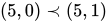


Uniqueness
For every utility function v, there is a unique preference relation represented by v. However, the opposite is not true: a preference relation may be represented by many different utility functions. The same preferences could be expressed as any utility function that is a monotonically increasing transformation of v. E.g., if
- v(A)≡f(v(A)){displaystyle v(A)equiv f(v(A))}

where f:R→R{displaystyle f:mathbb {R} to mathbb {R} }
This equivalence is succinctly described in the following way:
- An ordinal utility function is unique up to increasing monotone transformation.
In contrast, a cardinal utility function is only unique up to increasing affine transformation. Every affine transformation is monotone; hence, if two functions are cardinally equivalent they are also ordinally equivalent, but not vice versa.
Monotonicity
Suppose, from now on, that the set X{displaystyle X}
Then under certain circumstances a preference relation ⪯{displaystyle preceq }
Suppose the preference relation is monotonically increasing, which means that "more is always better":
- x<x′⟹(x,y)≺(x′,y){displaystyle x<x'implies (x,y)prec (x',y)}
- y<y′⟹(x,y′)≺(x,y′){displaystyle y<y'implies (x,y')prec (x,y')}


Then, both partial derivatives, if they exist, of v are positive. In short:
- If a utility function represents a monotonically increasing preference relation, then the utility function is monotonically increasing.
Marginal rate of substitution
Suppose a person has a bundle (x0,y0){displaystyle (x_{0},y_{0})}



This definition of the MRS is based only on the ordinal preference relation – it does not depend on a numeric utility function. If the preference relation is represented by a utility function and the function is differentiable, then the MRS can be calculated from the derivatives of that function:
- MRS=vx′vy′.{displaystyle MRS={frac {v'_{x}}{v'_{y}}}.}
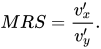
For example, if the preference relation is represented by v(x,y)=xa⋅yb{displaystyle v(x,y)=x^{a}cdot y^{b}}
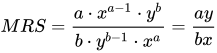

In general, the MRS may be different at different points (x0,y0){displaystyle (x_{0},y_{0})}


Linearity
When the MRS of a certain preference relation does not depend on the bundle, i.e., the MRS is the same for all (x0,y0){displaystyle (x_{0},y_{0})}
- x+λy=const,{displaystyle x+lambda y={text{const}},}

and the preference relation can be represented by a linear function:
- v(x,y)=x+λy.{displaystyle v(x,y)=x+lambda y.}

(Of course, the same relation can be represented by many other non-linear functions, such as x+λy{displaystyle {sqrt {x+lambda y}}}

Quasilinearity
When the MRS depends on y0{displaystyle y_{0}}

- v(x,y)=x+γvY(y){displaystyle v(x,y)=x+gamma v_{Y}(y)}

where vY{displaystyle v_{Y}}

- vY(y)=∫0yλ(y′)dy′{displaystyle v_{Y}(y)=int _{0}^{y}{lambda (y')dy'}}
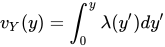
In this case, all the indifference curves are parallel – they are horizontal transfers of each other.
Additivity with two goods
A more general type of utility function is an additive function:
- v(x,y)=vX(x)+vY(y){displaystyle v(x,y)=v_{X}(x)+v_{Y}(y)}

There are several ways to check whether given preferences are representable by an additive utility function.
Double cancellation property
If the preferences are additive then a simple arithmetic calculation shows that
(x1,y1)⪰(x2,y2){displaystyle (x_{1},y_{1})succeq (x_{2},y_{2})}and
(x2,y3)⪰(x3,y1){displaystyle (x_{2},y_{3})succeq (x_{3},y_{1})}implies
- (x1,y3)⪰(x3,y2){displaystyle (x_{1},y_{3})succeq (x_{3},y_{2})}

so this "double-cancellation" property is a necessary condition for additivity.
Debreu (1960) showed that this property is also sufficient: i.e., if a preference relation satisfies the double-cancellation property then it can be represented by an additive utility function.[7]
Corresponding tradeoffs property
If the preferences are represented by an additive function, then a simple arithmetic calculation shows that
- MRS(x2,y2)=MRS(x1,y2)⋅MRS(x2,y1)MRS(x1,y1){displaystyle MRS(x_{2},y_{2})={frac {MRS(x_{1},y_{2})cdot MRS(x_{2},y_{1})}{MRS(x_{1},y_{1})}}}

so this "corresponding tradeoffs" property is a necessary condition for additivity.
This condition is also sufficient.[8][5]:91
Additivity with three or more goods
When there are three or more commodities, the condition for the additivity of the utility function is surprisingly simpler than for two commodities. This is an outcome of Theorem 3 of Debreu (1960). The condition required for additivity is preferential independence.[5]:104
A subset A of commodities is said to be preferentially independent of a subset B of commodities, if the preference relation in subset A, given constant values for subset B, is independent of these constant values. For example, suppose there are three commodities: x y and z. The subset {x,y} is preferentially-independent of the subset {z}, if for all xi,yi,z,z′{displaystyle x_{i},y_{i},z,z'}
(x1,y1,z)⪯(x2,y2,z)⟺(x1,y1,z′)⪯(x2,y2,z′){displaystyle (x_{1},y_{1},z)preceq (x_{2},y_{2},z)iff (x_{1},y_{1},z')preceq (x_{2},y_{2},z')}.
In this case, we can simply say that:
(x1,y1)⪯(x2,y2){displaystyle (x_{1},y_{1})preceq (x_{2},y_{2})}for constant z.
Preferential independence makes sense in case of independent goods. For example, the preferences between bundles of apples and bananas are probably independent of the number of shoes and socks that an agent has, and vice versa.
By Debreu's theorem, if all subsets of commodities are preferentially independent of their complements, then the preference relation can be represented by an additive value function. Here we provide an intuitive explanation of this result by showing how such an additive value function can be constructed.[5] The proof assumes three commodities: x, y, z. We show how to define three points for each of the three value functions vx,vy,vz{displaystyle v_{x},v_{y},v_{z}}
0 point: choose arbitrary x0,y0,z0{displaystyle x_{0},y_{0},z_{0}}
- vx(x0)=vy(y0)=vz(z0)=0{displaystyle v_{x}(x_{0})=v_{y}(y_{0})=v_{z}(z_{0})=0}

1 point: choose arbitrary x1>x0{displaystyle x_{1}>x_{0}}

- vx(x1)=1{displaystyle v_{x}(x_{1})=1}

Choose y1{displaystyle y_{1}}

(x1,y0,z0)∼(x0,y1,z0)∼(x0,y0,z1){displaystyle (x_{1},y_{0},z_{0})sim (x_{0},y_{1},z_{0})sim (x_{0},y_{0},z_{1})}.
This indifference serves to scale the units of y and z to match those of x. The value in these three points should be 1, so we assign
- vy(y1)=vz(z1)=1{displaystyle v_{y}(y_{1})=v_{z}(z_{1})=1}

2 point: Now we use the preferential-independence assumption. The relation between (x1,y0){displaystyle (x_{1},y_{0})}


- (x1,y0,z1)∼(x0,y1,z1)∼(x1,y1,z0).{displaystyle (x_{1},y_{0},z_{1})sim (x_{0},y_{1},z_{1})sim (x_{1},y_{1},z_{0}).}

This is useful because it means that the function v can have the same value – 2 – in these three points. Select x2,y2,z2{displaystyle x_{2},y_{2},z_{2}}
- (x2,y0,z0)∼(x0,y2,z0)∼(x0,y0,z2)∼(x1,y1,z0){displaystyle (x_{2},y_{0},z_{0})sim (x_{0},y_{2},z_{0})sim (x_{0},y_{0},z_{2})sim (x_{1},y_{1},z_{0})}

and assign
- vx(x2)=vx(y2)=vx(z2)=2.{displaystyle v_{x}(x_{2})=v_{x}(y_{2})=v_{x}(z_{2})=2.}

3 point: To show that our assignments so far are consistent, we must show that all points that receive a total value of 3 are indifference points. Here, again, the preferential independence assumption is used, since the relation between (x2,y0){displaystyle (x_{2},y_{0})}
- (x2,y0,z1)∼(x1,y1,z1){displaystyle (x_{2},y_{0},z_{1})sim (x_{1},y_{1},z_{1})}

and similarly for the other pairs. Hence, the 3 point is defined consistently.
We can continue like this by induction and define the per-commodity functions in all integer points, then use continuity to define it in all real points.
An implicit assumption in point 1 of the above proof is that all three commodities are essential or preference relevant.[7]:7 This means that there exists a bundle such that, if the amount of a certain commodity is increased, the new bundle is strictly better.
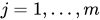
The proof for more than 3 commodities is similar. In fact, we do not have to check that all subsets of points are preferentially independent; it is sufficient to check a linear number of pairs of commodities. E.g., if there are m{displaystyle m}



Uniqueness of additive representation
An additive preference relation can be represented by many different additive utility functions. However, all these functions are similar: they are not only increasing monotone transformations of each other (as are all utility functions representing the same relation); they are increasing linear transformations of each other.[7]:9 In short,
- An additive ordinal utility function is unique up to increasing linear transformation.
Comparison between ordinal and cardinal utility functions
The following table compares the two types of utility functions common in economics:
| Level of measurement | Represents preferences on | Unique up to | Existence proved by | Mostly used in | |
|---|---|---|---|---|---|
| Ordinal utility | Ordinal scale | Sure outcomes | Increasing monotone transformation | Debreu (1954) | Consumer theory under certainty |
| Cardinal utility | Interval scale | Random outcomes (lotteries) | Increasing monotone linear transformation | Von Neumann-Morgenstern (1947) | Game theory, choice under uncertainty |
See also
- Preference (economics)
- Multi-attribute utility
- Consumer theory
- Marginal utility
- Lattice theory
- Convex preferences
References
^ Pareto, Vilfredo (1906). "Manuale di economia politica, con una introduzione alla scienza sociale". Societa Editrice Libraria..mw-parser-output cite.citation{font-style:inherit}.mw-parser-output .citation q{quotes:"""""""'""'"}.mw-parser-output .citation .cs1-lock-free a{background:url("//upload.wikimedia.org/wikipedia/commons/thumb/6/65/Lock-green.svg/9px-Lock-green.svg.png")no-repeat;background-position:right .1em center}.mw-parser-output .citation .cs1-lock-limited a,.mw-parser-output .citation .cs1-lock-registration a{background:url("//upload.wikimedia.org/wikipedia/commons/thumb/d/d6/Lock-gray-alt-2.svg/9px-Lock-gray-alt-2.svg.png")no-repeat;background-position:right .1em center}.mw-parser-output .citation .cs1-lock-subscription a{background:url("//upload.wikimedia.org/wikipedia/commons/thumb/a/aa/Lock-red-alt-2.svg/9px-Lock-red-alt-2.svg.png")no-repeat;background-position:right .1em center}.mw-parser-output .cs1-subscription,.mw-parser-output .cs1-registration{color:#555}.mw-parser-output .cs1-subscription span,.mw-parser-output .cs1-registration span{border-bottom:1px dotted;cursor:help}.mw-parser-output .cs1-ws-icon a{background:url("//upload.wikimedia.org/wikipedia/commons/thumb/4/4c/Wikisource-logo.svg/12px-Wikisource-logo.svg.png")no-repeat;background-position:right .1em center}.mw-parser-output code.cs1-code{color:inherit;background:inherit;border:inherit;padding:inherit}.mw-parser-output .cs1-hidden-error{display:none;font-size:100%}.mw-parser-output .cs1-visible-error{font-size:100%}.mw-parser-output .cs1-maint{display:none;color:#33aa33;margin-left:0.3em}.mw-parser-output .cs1-subscription,.mw-parser-output .cs1-registration,.mw-parser-output .cs1-format{font-size:95%}.mw-parser-output .cs1-kern-left,.mw-parser-output .cs1-kern-wl-left{padding-left:0.2em}.mw-parser-output .cs1-kern-right,.mw-parser-output .cs1-kern-wl-right{padding-right:0.2em}
^ Chiaki Hara (6 June 1998). "Revealed Preference Theory". 7th Toiro-kai meeting (1997/1998).
^ Botond Koszegi; Matthew Rabin (May 2007). "Mistakes in Choice-Based Welfare Analysis" (PDF). American Economic Review: Papers and Proceedings. 97 (2): 477–481. CiteSeerX 10.1.1.368.381. doi:10.1257/aer.97.2.477. Archived from the original (PDF) on 2008-10-15.
^ ab Ariel Rubinstein, Lecture Notes in Microeconomic Theory, Lecture 2 – Utility
^ abcdefg Keeney, Ralph L.; Raiffa, Howard (1993). Decisions with Multiple Objectives. ISBN 978-0-521-44185-8.
^ Peter Mark Pruzan and J. T. Ross Jackson (1963). "On the Development of Utility Spaces for Multi-Goal Systems". Ledelse og Erhvervsøkonomi/Handelsvidenskabeligt Tidsskrift/Erhvervsøkonomisk Tidsskrift.
^ abc Bergstrom, Ted. "Lecture Notes on Separable Preferences" (PDF). UCSB Econ. Retrieved 18 August 2015.
^ Luce, R.Duncan; Tukey, John W. (1964). "Simultaneous conjoint measurement: A new type of fundamental measurement". Journal of Mathematical Psychology. 1: 1–27. CiteSeerX 10.1.1.334.5018. doi:10.1016/0022-2496(64)90015-x.
External links
Lexicographic preference relation cannot be represented by a utility function. In Economics.SE
Recognizing linear orders embeddable in R2 ordered lexicographically. In Math.SE.
Murray N. Rothbard, "Towards a Reconstruction of Utility and Welfare Economics"
https://www.pornktube.com


