Adnyamathanha language
| Adnyamathanha | |
|---|---|
| Region | South Australia |
Native speakers | 140 (2016 census)[1] |
Language family | Pama–Nyungan
|
| Language codes | |
| ISO 639-3 | Either: adt – Adnyamathanhagvy – Guyani |
| Glottolog | adny1235 Adnyamathanha[2]guya1249 Guyani[3] |
AIATSIS[4] | L10 Adnyamathanha, L9 Kuyani |
Adnyamathanha (pronounced /ˈɑːdnjəmʌdənə/; many other names, see below) or yura ngarwala is an Australian Aboriginal language. It is the traditional language of the Adnyamathanha people.
The name of the witchetty grub comes from Adnyamathanha.
Estimates of the number of people who speak Adnyamathanha are variable, though it is definitely severely endangered. According to Oates 1973 there were only 30 speakers, around 20 according to Schmidt in 1990, 127 in the 1996 census, and about 107 counted in the 2006 census.[5]
Yura ngarwala is a widely used term for the Adnyamathanha language. It translates literally to 'people speak'. However, in modern times yura has come to mean 'Adnyamathanha person', rather than 'person' generally, and thus the term translates to 'Adnyamathanha person speak'.
Contents
1 Names
2 Classification
3 Phonology
3.1 Vowels
3.2 Consonants
3.3 History
4 Grammar
5 Vocabulary
5.1 'Witchetty grub'
6 Notes
7 References
8 External links
Names
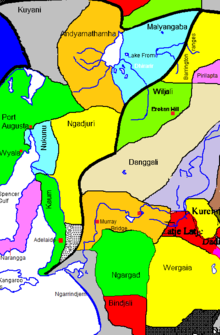
Aboriginal Tribes near Adelaide.
This language has been known by many names and variants of names, including:
Adnyamathanha, Adynyamathanha, Adjnjamathanha, Atʸnʸamat̪an̪a, Adnjamathanha, Adnyamathana, Anyamathana, Ad'n'amadana, Anjimatana, Anjiwatana, Unyamootha
Wailpi, Wailbi, Waljbi, Wipie, the name of a dialect- Archualda
- Benbakanjamata
- Binbarnja
Gadjnjamada, Kanjimata, Keydnjmarda
- Jandali
- Mardala
- Nimalda
- Nuralda
- Umbertana
- Yura ngarwala
Guyani is also spelled Kijani, Kuyani, Kwiani.
Classification
R. M. W. Dixon classifies Adnyamathanha and Guyani as a single language. Ethnologue treats them as separate, and so they each have their own ISO 639-3 codes.
Phonology
Adjnjamathanha and Guyani have the same phonemic inventory.
Vowels
Front | Back | |
|---|---|---|
High | i iː | u uː |
Low | a aː | |
Consonants
Most of the nasals and laterals are allophonically prestopped.[6]
Peripheral | Laminal | Apical | ||||||
|---|---|---|---|---|---|---|---|---|
Labial | Velar | Palatal | Dental | Alveolar | Retroflex | Glottal | ||
Plosive | voiceless | p | k | c | t̪ | t | ʈ | (ʔ) |
voiced | (ɖ ) | |||||||
Fricative | voiced | (v) | ||||||
Nasal | m ~ bm | ŋ | ɲ ~ ɟɲ | n̪ ~ d̪n̪ | n ~ dn | ɳ ~ ɖɳ | ||
Lateral | ʎ ~ ɟʎ | l̪ ~ d̪l̪ | l ~ dl | ɭ ~ ɖɭ | ||||
Flap | ɾ | ɽ | ||||||
Trill | r | |||||||
Approximant | w | j | ɻ | |||||
[v] may be an allophone of /p/.
History
While the closely related Guyani retains word-initial stops, Adnyamathanha has undergone systematic lenition of stops in this position. Former *p has become [v], former *t̪ and probably also *c have become /j/, and former *k has disappeared entirely.
Grammar
Adnyamathanha has a complex system of personal pronouns. There are 10 different ways of saying we ‘you and I’ (first person dual), depending on the relationship between the speaker and the addressee.
Vocabulary
'Witchetty grub'

A couple of witchetty grubs.
The word witchetty comes from Adynyamathanha wityu, "hooked stick" and vartu, "grub". Traditionally it is rare for men to dig for them. Witchetty grubs feature as Dreamings in many Aboriginal paintings. Once caught the grubs leak a brown water juice over fingers when held.[citation needed]
Notes
^ "Census 2016, Language spoken at home by Sex (SA2+)". abs.gov.au. Australian Bureau of Statistics. Retrieved 28 October 2017..mw-parser-output cite.citation{font-style:inherit}.mw-parser-output q{quotes:"""""""'""'"}.mw-parser-output code.cs1-code{color:inherit;background:inherit;border:inherit;padding:inherit}.mw-parser-output .cs1-lock-free a{background:url("//upload.wikimedia.org/wikipedia/commons/thumb/6/65/Lock-green.svg/9px-Lock-green.svg.png")no-repeat;background-position:right .1em center}.mw-parser-output .cs1-lock-limited a,.mw-parser-output .cs1-lock-registration a{background:url("//upload.wikimedia.org/wikipedia/commons/thumb/d/d6/Lock-gray-alt-2.svg/9px-Lock-gray-alt-2.svg.png")no-repeat;background-position:right .1em center}.mw-parser-output .cs1-lock-subscription a{background:url("//upload.wikimedia.org/wikipedia/commons/thumb/a/aa/Lock-red-alt-2.svg/9px-Lock-red-alt-2.svg.png")no-repeat;background-position:right .1em center}.mw-parser-output .cs1-subscription,.mw-parser-output .cs1-registration{color:#555}.mw-parser-output .cs1-subscription span,.mw-parser-output .cs1-registration span{border-bottom:1px dotted;cursor:help}.mw-parser-output .cs1-hidden-error{display:none;font-size:100%}.mw-parser-output .cs1-visible-error{font-size:100%}.mw-parser-output .cs1-subscription,.mw-parser-output .cs1-registration,.mw-parser-output .cs1-format{font-size:95%}.mw-parser-output .cs1-kern-left,.mw-parser-output .cs1-kern-wl-left{padding-left:0.2em}.mw-parser-output .cs1-kern-right,.mw-parser-output .cs1-kern-wl-right{padding-right:0.2em}
^ Hammarström, Harald; Forkel, Robert; Haspelmath, Martin, eds. (2017). "Adnyamathanha". Glottolog 3.0. Jena, Germany: Max Planck Institute for the Science of Human History.
^ Hammarström, Harald; Forkel, Robert; Haspelmath, Martin, eds. (2017). "Guyani". Glottolog 3.0. Jena, Germany: Max Planck Institute for the Science of Human History.
^ Adnyamathanha at the Australian Indigenous Languages Database, Australian Institute of Aboriginal and Torres Strait Islander Studies (see the info box for additional links)
^ "AUSTLANG". austlang.aiatsis.gov.au. Retrieved 2015-09-12.
^ Jeff Mielke, 2008. The emergence of distinctive features, p 135
References
Dixon, R. M. W. (2002). Australian Languages: Their Nature and Development. Cambridge University Press. ISBN 978-0-521-47378-1. ,.
Schebeck, B. (1974). Texts on the social system of the Atʸnʸamat̪an̪a people, with grammatical notes. Canberra: Pacific Linguistics.
External links
Bibliography of Adnyamathanha resources, at the Australian Institute of Aboriginal and Torres Strait Islander Studies


