Float (nautical)
Floats (also called pontoons) are airtight hollow structures, similar to pressure vessels, designed to provide buoyancy in water. Their principal applications are in watercraft hulls and aircraft floats, floating pier and pontoon bridge construction, and marine engineering applications such as salvage.
Various objects that make use of floats are often referred to synecdochically as pontoons.
Contents
1 Applications
1.1 Pontoon boat
1.2 Anchored recreational platform
1.3 Floating dock
1.4 Pontoon bridge
1.5 Floatplane
2 Construction
3 Gallery
4 See also
5 References
Applications
Floats make up the multipart hulls of catamarans and trimarans and provide buoyancy for floatplanes, seaplanes and houseboats.[1] They are used in pontoon bridges, floating piers, and floats anchored to the seabed for recreation or dockage. They are also used in shipbuilding and marine salvage, often deployed uninflated then pressurized to raise a sunken object.
In popular usage, the term pontoon can refer to any of several of the following objects that make use of nautical floats.
Pontoon boat
A pontoon boat is a flattish boat that relies on nautical floats for buoyancy. Common boat designs are a catamaran with two pontoons, or a trimaran with three.[2] In many parts of the world, pontoon boats are used as small vehicle ferries to cross rivers and lakes.[3]

An anchored raft-like platform used for diving, often referred to as a pontoon
Anchored recreational platform
In Australia and New Zealand, the term "pontoon" often refers to an anchored raft-like platform used for diving from. Pontoons are located at many beaches (particularly those at which swimming classes are taught) and lake shores, but usually only during the summer months.
Floating dock
A floating dock, floating pier or floating jetty consists of a platform or ramp supported by nautical floats. It is usually joined to the shore with a gangway. This type of pier maintains a fixed vertical relationship to watercraft secured to it.
Pontoon bridge
A pontoon bridge (also known as a ponton bridge or floating bridge) uses floats or shallow-draft boats to support a continuous deck for pedestrian and vehicle travel. Most pontoon bridges are temporary, used in wartime and civil emergencies.[4]

Floats on a Cessna 208 Caravan 1 floatplane, Gloucestershire Airport, England (2017)
Floatplane
A floatplane (float plane or pontoon plane) is a type of seaplane with one or more slender pontoons mounted under the fuselage to provide buoyancy.
Construction
Pontoons for marine industrial uses are usually fabricated from steel.[5] Pontoons as parts of watercraft and aircraft are more typically molded in glass-reinforced plastic. Other techniques include those of traditional wooden boatbuilding as well as plywood over wooden ribs or metal sheets over metal ribs (aluminium or steel), reflecting the prevailing practice in aircraft and boats.
In model building, floats can easily be carved out of solid blocks or laminated sheets of foam.[6]
Gallery

Small open catamaran.

Foldable trimaran with the floats in extended position.
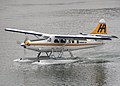
Floats in a small floatplane.

A helicopter pontoon augmented by an inflatable emergency pontoon shown in black

The underside of a boat during construction


See also
- Navy lighterage pontoons
- Semi-submersible platform
- Outrigger
- Buoy
- Raft
- Caisson (lock gate)
References
 | Wikimedia Commons has media related to Pontoons. |
^ The Cruising Multihull. 978-0070698680: International Marine/Ragged Mountain Press. 1996. p. 45. Retrieved 2009-05-27..mw-parser-output cite.citation{font-style:inherit}.mw-parser-output q{quotes:"""""""'""'"}.mw-parser-output code.cs1-code{color:inherit;background:inherit;border:inherit;padding:inherit}.mw-parser-output .cs1-lock-free a{background:url("//upload.wikimedia.org/wikipedia/commons/thumb/6/65/Lock-green.svg/9px-Lock-green.svg.png")no-repeat;background-position:right .1em center}.mw-parser-output .cs1-lock-limited a,.mw-parser-output .cs1-lock-registration a{background:url("//upload.wikimedia.org/wikipedia/commons/thumb/d/d6/Lock-gray-alt-2.svg/9px-Lock-gray-alt-2.svg.png")no-repeat;background-position:right .1em center}.mw-parser-output .cs1-lock-subscription a{background:url("//upload.wikimedia.org/wikipedia/commons/thumb/a/aa/Lock-red-alt-2.svg/9px-Lock-red-alt-2.svg.png")no-repeat;background-position:right .1em center}.mw-parser-output .cs1-subscription,.mw-parser-output .cs1-registration{color:#555}.mw-parser-output .cs1-subscription span,.mw-parser-output .cs1-registration span{border-bottom:1px dotted;cursor:help}.mw-parser-output .cs1-hidden-error{display:none;font-size:100%}.mw-parser-output .cs1-visible-error{font-size:100%}.mw-parser-output .cs1-subscription,.mw-parser-output .cs1-registration,.mw-parser-output .cs1-format{font-size:95%}.mw-parser-output .cs1-kern-left,.mw-parser-output .cs1-kern-wl-left{padding-left:0.2em}.mw-parser-output .cs1-kern-right,.mw-parser-output .cs1-kern-wl-right{padding-right:0.2em}
^ Hearst Magazines (January 1990). Popular Mechanics. Hearst Magazines. pp. 48–. ISSN 0032-4558.
^ Bonnier Corporation (July 1931). Popular Science. Bonnier Corporation. pp. 64–. ISSN 0161-7370.
^ Leonardo Fernández Troyano (2003). Bridge Engineering: A Global Perspective. Thomas Telford. pp. 692–. ISBN 978-0-7277-3215-6.
^ Gregory P. Tsinker (2004). Port Engineering: Planning, Construction, Maintenance, and Security. John Wiley & Sons. pp. 452–. ISBN 978-0-471-41274-8.
^ http://www.rc-float-flying.rchomepage.com/Glow%20Cores/floatcores.htm


