Codex Seidelianus I
New Testament manuscript
| |
 Codex Seidelianus I | |
| Name | Seidelianus I |
|---|---|
| Sign | Ge |
| Text | Gospels |
| Date | 9th century |
| Script | Greek |
| Now at | British Library |
| Size | 25.7 cm by 21.5 cm |
| Type | Byzantine text-type |
| Category | V |
| Hand | coarse |
Codex Seidelianus I, designated by siglum Ge or 011 (in the Gregory-Aland numbering), ε 87 (von Soden), also known as Codex Wolfii A and Codex Harleianus [1] is a Greek uncial manuscript of the Gospels, dated palaeographically to the 9th century (or 10th century). The codex contains 252 parchment leaves (25.7 cm by 21.5 cm).[2] The manuscript is lacunose.
Contents
1 Description
2 Text
3 History
4 See also
5 References
6 Further reading
7 External links
Description
The codex contains the text of the four Gospels with some lacunae (Matthew 1:1-6:6, 7:25-8:9, 8:23-9:2, 28:18-Mark 1:13, Mark 14:19-25, Luke 1:1-13, 5:4-7:3, 8:46-9:5, 12:27-41, 24:41-end, John 18:5-19, 19:4-27).[3]
The text is written in 2 columns per page, 21 lines per page.[2] It was written in a coarse hand.
The text is divided according to the Ammonian Sections, whose numbers are given at the margin, with references to the Eusebian Canons. It contains the τιτλοι (titles of chapters). It has breathings and accents, but often irregularly.[3] Each member of the genealogy in Luke 3 forms a separate line.[4]
Some portions of these lacunae are rectified by a later hand.
Text
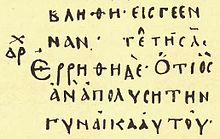
Scrivener's ficsimile with text of Matthew 5:30-31
The Greek text of this codex is a secondary representative of the Byzantine text-type with many of the non-Byzantine readings seeming to be the Caesarean. Aland gave to it textual profile 1761 871/2 42 21s and placed it in Category V.[2]Hermann von Soden classified it to the family Ki, but according to the Claremont Profile Method it belongs to the textual family Kx.[5]
History
The codex was brought from the East to Germany by Seidel († 1718). After his death in 1718 Maturin Veyssière de La Croze, royal librarian from Berlin acquired it and presented to Wolf,[6][7] who published extracts from its text in 1723.[8] The codex was barbarously mutilated in 1721 in order to send pieces to Bentley. Most of them were purchased by Eduard Harley. Some of fragments were found by Tregelles in 1845. Tregelles collated its text in 1847.[9]
The codex was known to Wettstein, who gave siglum G for it.[6]Griesbach designated it by the same siglum.[10]
Later it became part of the library of Edward Harley, now is located, in the British Library (Harley 5684), and one page, which Wolff gave to Richard Bentley, is in Cambridge in the (Trinity College B. XVII. 20).[2][11]
See also

- List of New Testament uncials
- Textual criticism
References
^ Metzger, Bruce M. (1968). The Text of the New Testament: Its Transmission, Corruption and Restoration (2 ed.). Oxford: Oxford University Press. p. 74. ISBN 978-0-19-516122-9..mw-parser-output cite.citation{font-style:inherit}.mw-parser-output q{quotes:"""""""'""'"}.mw-parser-output code.cs1-code{color:inherit;background:inherit;border:inherit;padding:inherit}.mw-parser-output .cs1-lock-free a{background:url("//upload.wikimedia.org/wikipedia/commons/thumb/6/65/Lock-green.svg/9px-Lock-green.svg.png")no-repeat;background-position:right .1em center}.mw-parser-output .cs1-lock-limited a,.mw-parser-output .cs1-lock-registration a{background:url("//upload.wikimedia.org/wikipedia/commons/thumb/d/d6/Lock-gray-alt-2.svg/9px-Lock-gray-alt-2.svg.png")no-repeat;background-position:right .1em center}.mw-parser-output .cs1-lock-subscription a{background:url("//upload.wikimedia.org/wikipedia/commons/thumb/a/aa/Lock-red-alt-2.svg/9px-Lock-red-alt-2.svg.png")no-repeat;background-position:right .1em center}.mw-parser-output .cs1-subscription,.mw-parser-output .cs1-registration{color:#555}.mw-parser-output .cs1-subscription span,.mw-parser-output .cs1-registration span{border-bottom:1px dotted;cursor:help}.mw-parser-output .cs1-hidden-error{display:none;font-size:100%}.mw-parser-output .cs1-visible-error{font-size:100%}.mw-parser-output .cs1-subscription,.mw-parser-output .cs1-registration,.mw-parser-output .cs1-format{font-size:95%}.mw-parser-output .cs1-kern-left,.mw-parser-output .cs1-kern-wl-left{padding-left:0.2em}.mw-parser-output .cs1-kern-right,.mw-parser-output .cs1-kern-wl-right{padding-right:0.2em}
^ abcd Aland, Kurt; Aland, Barbara (1995). The Text of the New Testament: An Introduction to the Critical Editions and to the Theory and Practice of Modern Textual Criticism. Erroll F. Rhodes (trans.). Grand Rapids: William B. Eerdmans Publishing Company. p. 110. ISBN 978-0-8028-4098-1.
^ ab Gregory, Caspar René (1900). Textkritik des Neuen Testamentes. 1. Leipzig: J.C. Hinrichs’sche Buchhandlung. p. 51.
^ Scrivener, Frederick Henry Ambrose; Edward Miller (1894). A Plain Introduction to the Criticism of the New Testament. 1 (4 ed.). London: George Bell & Sons. p. 135.
^ Frederik Wisse, The Profile Method for the Classification and Evaluation of Manuscript Evidence, as Applied to the Continuous Greek Text of the Gospel of Luke, William B. Eerdmans Publishing, (Grand Rapids, 1982), p. 52
^ ab Wettstein, Johann Jakob (1751). Novum Testamentum Graecum editionis receptae cum lectionibus variantibus codicum manuscripts (in Latin). 1. Amsterdam: Ex Officina Dommeriana. p. 40. Retrieved November 14, 2010.
^ C. v. Tischendorf, Novum Testamentum Graece. Editio Septima, Lipsiae 1859, p. CLV.
^ Metzger, Bruce M. (1968). The Text of the New Testament: Its Transmission, Corruption and Restoration (2 ed.). Oxford: Oxford University Press. p. 75. ISBN 978-0-19-516122-9.
^ Samuel Prideaux Tregelles, An Account of the Printed Text, pp. 159-160
^ J. J. Griesbach, Novum Testamentum Graece, Londini 1809, s. XCIX
^ "Liste Handschriften". Münster: Institute for New Testament Textual Research. Retrieved 16 March 2013.
Further reading
- J. C. Wolff, "Anecdota Graeca" (Hamburg, 1723), III, pp. 48–92.
S. P. Tregelles, Account of the Printed Text, p. 160.
External links
- R. Waltz, Codex Seidelianus Ge (011): at the Encyclopedia of Textual Criticism (2007)
Images at the British Library
Harley MS 5684 BL


