Potassium sulfide
 | |
| Names | |
|---|---|
IUPAC name Potassium sulfide | |
| Other names Dipotassium monosulfide, Dipotassium sulfide, Potassium monosulfide, Potassium sulfide | |
| Identifiers | |
CAS Number |
|
3D model (JSmol) |
|
ChemSpider |
|
ECHA InfoCard | 100.013.816 |
PubChem CID |
|
RTECS number | TT6000000 |
InChI
| |
SMILES
| |
| Properties | |
Chemical formula | K2S |
Molar mass | 110.262 g/mol |
| Appearance | pure: colourless impure: yellow-brown |
Odor | H2S |
Density | 1.74 g/cm3 |
Melting point | 840 °C (1,540 °F; 1,110 K) |
Boiling point | 912 °C (1,674 °F; 1,185 K) (decomposes) |
Solubility in water | converts to KSH, KOH |
Solubility in other solvents | soluble in ethanol, glycerol insoluble in ether |
Magnetic susceptibility (χ) | −60.0·10−6 cm3/mol |
| Structure | |
Crystal structure | antiFluorite |
| Hazards | |
| Main hazards | Dangerous for the environment (N) |
R-phrases (outdated) | R17, R23, R25, R31, R34, R50 |
S-phrases (outdated) | S24, S26 |
| Related compounds | |
Other cations | Sodium sulfide, Iron(II) sulfide |
Related compounds | Potassium hydrosulfide, Potassium sulfite, Potassium sulfate |
Except where otherwise noted, data are given for materials in their standard state (at 25 °C [77 °F], 100 kPa). | |
 Y verify (what is Y verify (what is  Y Y N ?) N ?) | |
Infobox references | |
Potassium sulfide is the inorganic compound with the formula K2S. The colourless solid is rarely encountered, because it reacts readily with water, a reaction that affords potassium hydrosulfide (KSH) and potassium hydroxide (KOH). Most commonly, the term potassium sulfide refers loosely to this mixture, not the anhydrous solid.
Contents
1 Structure
2 Synthesis and reactions
3 Use in fireworks
4 See also
5 References
Structure
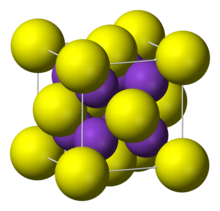
It adopts "antifluorite structure," which means that the small K+ ions occupy the tetrahedral (F−) sites in fluorite, and the larger S2− centers occupy the eight-coordinate sites. Li2S, Na2S, and Rb2S crystallize similarly.[1]
Synthesis and reactions
It can be produced by heating K2SO4 with carbon (coke):
- K2SO4 + 4 C → K2S + 4 CO
In the laboratory, pure K2S may be prepared by the reaction of potassium and sulfur in anhydrous ammonia. [2]
Sulfide is highly basic, consequently K2S completely and irreversibly hydrolyzes in water according to the following equation:
- K2S + H2O → KOH + KSH
For many purposes, this reaction is inconsequential since the mixture of SH− and OH− behaves as a source of S2−. Other alkali metal sulfides behave similarly.[1]
Use in fireworks
Potassium sulfides are formed when black powder is burned and are important intermediates in many pyrotechnic effects, such as senko hanabi and some glitter formulations.[3]
See also
- Liver of sulfur
References
^ ab Holleman, A. F.; Wiberg, E. "Inorganic Chemistry" Academic Press: San Diego, 2001. .mw-parser-output cite.citation{font-style:inherit}.mw-parser-output q{quotes:"""""""'""'"}.mw-parser-output code.cs1-code{color:inherit;background:inherit;border:inherit;padding:inherit}.mw-parser-output .cs1-lock-free a{background:url("//upload.wikimedia.org/wikipedia/commons/thumb/6/65/Lock-green.svg/9px-Lock-green.svg.png")no-repeat;background-position:right .1em center}.mw-parser-output .cs1-lock-limited a,.mw-parser-output .cs1-lock-registration a{background:url("//upload.wikimedia.org/wikipedia/commons/thumb/d/d6/Lock-gray-alt-2.svg/9px-Lock-gray-alt-2.svg.png")no-repeat;background-position:right .1em center}.mw-parser-output .cs1-lock-subscription a{background:url("//upload.wikimedia.org/wikipedia/commons/thumb/a/aa/Lock-red-alt-2.svg/9px-Lock-red-alt-2.svg.png")no-repeat;background-position:right .1em center}.mw-parser-output .cs1-subscription,.mw-parser-output .cs1-registration{color:#555}.mw-parser-output .cs1-subscription span,.mw-parser-output .cs1-registration span{border-bottom:1px dotted;cursor:help}.mw-parser-output .cs1-hidden-error{display:none;font-size:100%}.mw-parser-output .cs1-visible-error{font-size:100%}.mw-parser-output .cs1-subscription,.mw-parser-output .cs1-registration,.mw-parser-output .cs1-format{font-size:95%}.mw-parser-output .cs1-kern-left,.mw-parser-output .cs1-kern-wl-left{padding-left:0.2em}.mw-parser-output .cs1-kern-right,.mw-parser-output .cs1-kern-wl-right{padding-right:0.2em}
ISBN 0-12-352651-5.
^ Handbook of Preparative Inorganic Chemistry, 2nd Ed. Edited by G. Brauer, Academic Press, 1963, NY. Vol. 1. p. 360.
^ Shimizu, Takeo. "Fireworks: the Art, Science, and Technique." Pyrotechnica Publications: Austin, 1981.
ISBN 0-929388-05-4.


