Arbelos

An arbelos (grey region)
In geometry, an arbelos is a plane region bounded by three semicircles with three apexes such that each corner of each semicircle is shared with one of the others (connected), all on the same side of a straight line (the baseline) that contains their diameters.[1]
The earliest known reference to this figure is in the Book of Lemmas, where some of its mathematical properties are stated as Propositions 4 through 8.[2]
The word arbelos is Greek for 'shoemaker's knife'.
Contents
1 Properties
1.1 Area
1.2 Rectangle
1.3 Tangents
1.4 Archimedes' circles
2 Etymology
3 See also
4 References
5 Bibliography
6 External links
Properties
Two of the semicircles are necessarily concave, with arbitrary diameters a and b; the third semicircle is convex, with diameter a+b.[1]

Some special points on the arbelos.
Area
The area of the arbelos is equal to the area of a circle with diameter HA{displaystyle HA}
Proof: For the proof, reflect the line through the points B{displaystyle B}








Rectangle
Let D{displaystyle D}


Proof: The angles BDA{displaystyle BDA}, BHC{displaystyle BHC}
are right angles because they are inscribed in semicircles (by Thales' theorem). The quadrilateral ADHE{displaystyle ADHE}
Tangents
The line DE{displaystyle DE}
Proof: Since angle BDA is a right angle, angle DBA equals π/2 minus angle DAB. However, angle DAH also equals π/2 minus angle DAB (since angle HAB is a right angle). Therefore triangles DBA and DAH are similar. Therefore angle DIA equals angle DOH, where I is the midpoint of BA and O is the midpoint of AH. But AOH is a straight line, so angle DOH and DOA are supplementary angles. Therefore the sum of angles DIA and DOA is π. Angle IAO is a right angle. The sum of the angles in any quadrilateral is 2π, so in quadrilateral IDOA, angle IDO must be a right angle. But ADHE is a rectangle, so the midpoint O of AH (the rectangle's diagonal) is also the midpoint of DE (the rectangle's other diagonal). As I (defined as the midpoint of BA) is the center of semicircle BA, and angle IDE is a right angle, then DE is tangent to semicircle BA at D. By analogous reasoning DE is tangent to semicircle AC at E. Q.E.D.
Archimedes' circles
The altitude AH{displaystyle AH}
Etymology

The type of shoemaker's knife that gave its name to the figure
The name arbelos comes from Greek ἡ ἄρβηλος he árbēlos or ἄρβυλος árbylos, meaning "shoemaker's knife", a knife used by cobblers from antiquity to the current day, whose blade is said to resemble the geometric figure.
See also
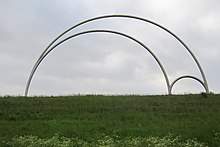
Arbelos skulpture in Kaatsheuvel, Netherlands
- Archimedes' quadruplets
- Bankoff circle
- Ideal triangle
- Schoch circles
- Schoch line
- Woo circles
- Pappus chain
- Salinon
References
^ ab Weisstein, Eric W. "Arbelos". MathWorld..mw-parser-output cite.citation{font-style:inherit}.mw-parser-output q{quotes:"""""""'""'"}.mw-parser-output code.cs1-code{color:inherit;background:inherit;border:inherit;padding:inherit}.mw-parser-output .cs1-lock-free a{background:url("//upload.wikimedia.org/wikipedia/commons/thumb/6/65/Lock-green.svg/9px-Lock-green.svg.png")no-repeat;background-position:right .1em center}.mw-parser-output .cs1-lock-limited a,.mw-parser-output .cs1-lock-registration a{background:url("//upload.wikimedia.org/wikipedia/commons/thumb/d/d6/Lock-gray-alt-2.svg/9px-Lock-gray-alt-2.svg.png")no-repeat;background-position:right .1em center}.mw-parser-output .cs1-lock-subscription a{background:url("//upload.wikimedia.org/wikipedia/commons/thumb/a/aa/Lock-red-alt-2.svg/9px-Lock-red-alt-2.svg.png")no-repeat;background-position:right .1em center}.mw-parser-output .cs1-subscription,.mw-parser-output .cs1-registration{color:#555}.mw-parser-output .cs1-subscription span,.mw-parser-output .cs1-registration span{border-bottom:1px dotted;cursor:help}.mw-parser-output .cs1-hidden-error{display:none;font-size:100%}.mw-parser-output .cs1-visible-error{font-size:100%}.mw-parser-output .cs1-subscription,.mw-parser-output .cs1-registration,.mw-parser-output .cs1-format{font-size:95%}.mw-parser-output .cs1-kern-left,.mw-parser-output .cs1-kern-wl-left{padding-left:0.2em}.mw-parser-output .cs1-kern-right,.mw-parser-output .cs1-kern-wl-right{padding-right:0.2em}
^ Thomas Little Heath (1897), The Works of Archimedes. Cambridge University Press. Proposition 4 in the Book of Lemmas. Quote: If AB be the diameter of a semicircle and N any point on AB, and if semicircles be described within the first semicircle and having AN, BN as diameters respectively, the figure included between the circumferences of the three semicircles is "what Archimedes called arbelos"; and its area is equal to the circle on PN as diameter, where PN is perpendicular to AB and meets the original semicircle in P. ("Arbelos - the Shoemaker's Knife")
^ Boas, Harold P. (2006). "Reflections on the Arbelos". Mathematical Association of America. 113: 236–249. doi:10.2307/27641891.
Bibliography
Johnson, R. A. (1960). Advanced Euclidean Geometry: An elementary treatise on the geometry of the triangle and the circle (reprint of 1929 edition by Houghton Miflin ed.). New York: Dover Publications. pp. 116&ndash, 117. ISBN 978-0-486-46237-0.
Ogilvy, C. S. (1990). Excursions in Geometry. Dover. pp. 51&ndash, 54. ISBN 0-486-26530-7.
Sondow, J. (2012). "The parbelos, a parabolic analog of the arbelos". arXiv:1210.2279 [math.HO].
American Mathematical Monthly, 120 (2013), 929-935.
Wells, D. (1991). The Penguin Dictionary of Curious and Interesting Geometry. New York: Penguin Books. pp. 5&ndash, 6. ISBN 0-14-011813-6.
External links
 Media related to Arbelos at Wikimedia Commons
 The dictionary definition of arbelos at Wiktionary
 Media related to Arbelos at Wikimedia Commons
 The dictionary definition of arbelos at Wiktionary

